Substantive Justice Over Statutory Deadline: Section 29A After C. Velusamy

Substantive Justice Over Statutory Deadline: Section 29A After C. Velusamy

  By Swarnava Sengupta & Namrata Ghosh

About the Author:

Swarnava Sengupta & Namrata Ghosh are fourth year law students at National Law University, Odisha.


Abstract

Section 29A of the Arbitration and Conciliation Act, 1996 (‘Act’) envisages time limit for completion of Arbitral Proceedings. Earlier, in Rohan Builders, the Supreme Court had held that an application to extend the time for making an arbitral award beyond the statutory mandate is maintainable even if filed after the expiry of the mandate. The Supreme Court recently, in C. Veluswamy v. K. Indhera (‘Velusamy’) expanded the maintainability of the application for the extension of the Tribunal’s mandate to situations where the arbitral award has been passed. This case clarifies the scope of the section in the post-award scenario in the backdrop of a tussle between substantive justice and procedural technicalities.

This post examines the implications of this judgment in three stages. First, it traces the factual matrix of the case and the judgment pronounced by the SC. Second, it focuses on the conundrum it creates for S. 29A and the doctrinal concerns it leaves unresolved. Finally, it evaluates the clarity Velusamy brings and how the judgment has tried to uphold party autonomy and the integrity of the Tribunal. 

I. From Appointment To Expiry: The Dispute In Context

A sole arbitrator was appointed by the Madras High Court on 19 April 2022. After pleadings closed on 20 August 2022, the 12-month period under Section 29A began, later extended by six months till 20 February 2024. Although the matter was reserved for award in September 2023, it was reopened for negotiation. When negotiations failed, the arbitrator delivered the award on 11 May 2024, after the mandate had expired. 

The Respondent challenged the award on Section 34 grounds that it was time-barred, and the Appellant on Section 29A(5) grounds that the award should be extended retrospectively. The High Court annulled the award and denied the extension. The Supreme Court ruled that an application under Section 29A(5) for extension of the mandate of the arbitrator is maintainable even after the expiry of the time under Sections 29A(1) and (3) and even after rendering of an award during that time. The power of the court to consider extension is not impaired and while considering the application, the Court will examine if there is sufficient cause for extending the mandate, and in the process, it may impose such terms and conditions as the situation demands.

This judgment envisages to promote procedural flexibility in arbitration by according primacy to substantive justice over technical formalities. The Court has tried to ensure that the invested time, financial resources, and evidence-based efforts of the parties in the arbitration proceedings do not go to waste. The verdict opined that if a reasoned award is deemed to be unenforceable solely on the grounds of delay, it will undermine the faith in arbitration.  

However, this judgment also raises concerns about the purpose of Section 29A, post award remedies, award enforceability and interpretive conflict.

Firstly, the verdict enables a party to file for a Section 29A application to seek an extension of the arbitral tribunal’s mandate even after an award has been passed by the tribunal after the lapse of 18 months prescribed period. It is unclear whether there would be any outer limit or limitation period for the Court to entertain such applications.

Notably, Section 34 is the only appeal mechanism under the Act, which has a limitation period of three months from the date on which the parties received the signed copy of the arbitral award. This judgment introduces uncertainty as to whether such proceedings would suspend, overlap with, or run parallel to the limitation clock prescribed under Section 34 by permitting post-award applications under Section 29A for retrospective extension of the tribunal’s mandate. Further, awards that were previously rendered unenforceable due to the expiry of the Tribunal’s mandate may now be revived through such application, encouraging parties to approach courts and seek retrospective validation. 

Secondly, the ruling has placed the status of an arbitral award passed after the expiry of mandate in a grey zone by characterising such awards as not non-est but merely unenforceable pending judicial extension under Section 29A of the Act. 

Thirdly, a bare reading of Section 29A of the Act states that if a tribunal fails to pass an award within a stipulated timeline, the tribunal’s mandate ‘shall’ be terminated mandatorily. As per the recent stance adopted by the Hon’ble Apex Court, minimal judicial interference is warranted and efforts should be made to sustain the arbitral awards passed by a tribunal. However, such approach should not be undertaken to validate an award passed by a tribunal which had previously become functus officio. This is further reinforced by the fact that the 1940 Act, provided for extension of the tribunal’s mandate irrespective of whether an award has been passed. The present Act, in absence of such provision indicates the legislature’s intention to exclude post award extension of tribunal’s mandate. Thus, accepting the contrary interpretation in the name of pro-arbitration policy would undermine the statutory discipline consciously introduced by the legislature through Section 29A.

Fourthly, this decision raises a conundrum when viewed in the context of the legal provisions pertaining to the mandate of the arbitral tribunal. Section 29A(4) of the Act has a proviso, wherein the mandate of the arbitrator continues till the extension application is disposed of. While Section 32(3) of the Act, on the other hand, provides that the mandate of a tribunal terminates with the termination of the arbitral proceedings. This decision affirms the court’s power to extend the mandate of the tribunal after the award and the termination of the mandate, creating tension due to the unclear implications of how a mandate, which has ceased to exist, can be revived or considered to continue. This overlap results in conflation of finality in the termination of mandate, thus broadening the scope of judicial intervention. 

Lastly, in Fatehpuria, the Court took a strong stance by ordering substitution to prevent delay and ensure the time-bound requirement under Section 29A of the Act, thus emphasising efficiency in arbitration. But Veluswamy expands the discretionary scope of substitution, thereby redefining it as an extraordinary measure to be taken with circumspection. This judicial development may weaken the deterrent against delay and even encourage laxness in procedure, thus defeating the purpose of speedy dispute resolution as embodied in the statute. 

This decision is a pivot move in jurisprudence of Section 29A. It would require rapid introduction of legislative changes to bring coherence and consistency between the emerging jurisprudence and the statutory text. In view of this, the Parliament should amend Section 29A to explicitly delimit the admissibility of post-award extension applications. In case such applications are allowed, an amendment should provide a reasonable time period within which they should be considered. Further, the retrospective application of the extension should be clarified specifically in order to identify whether it, implicitly, constitutes an automatic validation of the arbitral award. It is also crucial to determine the date of commencement of the Section 34 limitation period in case the award is rendered enforceable.

Moreover, to prevent the possibility of the misuse of such retrospective extensions to put back into life strategically deferred challenges, the Supreme Court should set out strictly defined parameters of what can be termed as “sufficient cause” in insofar as the extension of a mandate is concerned. Accordingly, the judiciary should exercise restraint in adjudicating such extension petitions, granting them solely under the most exceptional circumstances only.

Thus, Velusamy’s judgement should be made to serve as a safety valve and not as an alternative to bypass procedural discipline. Only through calibrated intervention can arbitration remain both efficient and just, without eroding statutory timelines or party confidence in the process.

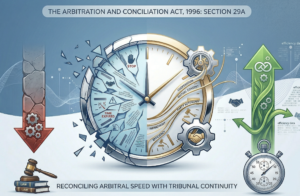
The Doctrinal Pendulum – From Mandatory Substitution to Structured Discretion under Section 29A

The Doctrinal Pendulum - From Mandatory Substitution to Structured Discretion under Section 29A

  By Ripudaman Rawat, Agrata Chaturvedi

About the Author:

Agrata is currently a 3rd year law student at Lloyd Law College and Ripudaman is currently a 2nd year law student at NALSAR University of Law, Hyderabad.


Abstract

Section 29A of the Arbitration and Conciliation Act, 1996 was built as a multi-layered deterrence mechanism against arbitral delay. In Viva Highways Ltd v. Madhya Pradesh Road Development Corporation Ltd (2026), the Supreme Court held that termination of an arbitrator’s mandate under Section 29A does not automatically require substitution which essentially was a departure from the “empowering and obligating” language of Mohan Lal Fatehpuria v. Bharat Textiles (2025). This comment asks whether treating substitution as an exceptional remedy protects procedural efficiency or quietly guts the statutory timeline’s deterrent logic. Drawing on comparative institutional practice and the legislative history of the 2015 Amendment, it proposes a graduated-response framework to reconcile time discipline with tribunal continuity and party autonomy.

Keywords: Section 29A, Arbitrator Substitution, Tribunal Mandate, Party Autonomy

I. Introduction

Section 29A [“S.29A”] of the Arbitration and Conciliation Act, 1996 was born from a specific diagnosis: delay as the greatest evil undermining Indian arbitration. Inserted by the 2015 Amendment, it imposed a twelve-month timeline for rendering awards, backed by escalating consequences i.e. fee reduction, and ultimately, substitution of the arbitral tribunal. Within a decade, two Supreme Court [“SC”] decisions have pulled that substitution mechanism in opposite directions, and the tension between them is more instructive than either decision alone.

In Mohan Lal Fatehpuria v. M/S Bharat Textiles [“Fatehpuria”], the Court declared that S.29A(6) “empowers and obligates” courts to substitute an arbitrator on mandate expiry. Barely two months later, in Viva Highways Ltd v. Madhya Pradesh Road Development Corporation Ltd [“Viva Highways”], the Court reinterpreted that language, holding that substitution would follow only “if the situation so warranted.” The Court held that this was not an overruling, but merely a clarification. But the clarification reversed the operational outcome, and that deserves attention.

The current debate surrounding S.29A centers on two conflicting approaches to an expired arbitral mandate. In Fatehpuria, the court enforced the rule of automatic substitution of the arbitrator, prioritizing strict adherence to statutory timelines, ensuring speedy resolution. In contrast, Viva Highways rejected this absolute mandate in favour of judicial discretion and allowed courts to extend the mandate without changing the tribunal, if the context warrants it. By moving away from automatic substitution, Viva Highways recognized a practical reality i.e. replacing an arbitrator without examining the underlying causes could be counterproductive.

The automatic substitution’s rule fails to distinguish between delays that are caused by an arbitrator’s inefficiency, party’s deliberate tactics or unavoidable systemic bottlenecks. Furthermore, forcing a newly appointed tribunal to restart the proceedings wastes both time and resources, ultimately undermining the very efficiency that S.29A aims to protect. However, replacing a strict rule with an unstructured discretion is only half an answer. Discretion without clear guidelines gives way to unpredictability, and unpredictability has its own costs for a provision whose logic depends on credible and consistent consequences, thereby neutralizing the deterrent effect. Therefore, the answer isn’t either Fatehpuria’s rigidity, or Viva Highways’ open-ended standard, but a graduated framework which focuses on context without leveraging the deterrent effect that S.29A was designed to create.

The 246th Report of the Law Commission of India identified delay as inherent in the arbitration process. Proceedings routinely stretched beyond a decade, and expeditious resolution has become a fiction. S.29A was the legislature’s response: not just deadlines, but a tiered structure of consequences.

S.29A(1) requires an award within twelve months from the date the tribunal enters upon reference; S.29A(3) allows parties, by mutual consent, to extend this by a further six months; Section S.29A(4) allows the court, on application, to grant further extensions, but where delay is attributable to the tribunal, it may order fee reduction of up to five per cent per month; Section S.29A(6) empowers the court, while extending time, to substitute the arbitrator(s).

The logic of this provision is inherently escalatory. The statutory time cap provides a structural baseline, escalating to financial penalties and ultimately substituting the tribunal. Each tier is designed to reinforce the one below it, therefore, if the threat of substitution is diluted by unpredictability, the entire disciplinary framework loses its teeth.

In Fatehpuria, an arbitrator appointed by the Delhi High Court had failed to render an award within the statutory period. (¶ 11) Rather than substituting him, the High Court simply extended his mandate. (¶ 12) The SC reversed this. Once a mandate expires under S.29A(4), the arbitrator becomes functus officio. (¶ 11) S.29A(6), the Court held, “empowers and obligates” courts to appoint a substitute. (¶ 13)  A new arbitrator was directed, with proceedings to continue from the stage already reached. (¶ 14) The decision treated substitution not as a discretionary remedy but as a structural consequence of expiry, an interpretation that left little room for judicial hesitation.

Viva Highways quietly dismantled this. The Madhya Pradesh High Court had done exactly what Fatehpuria seemed to require: on mandate expiry, it terminated the appointment and directed substitution. The SC set this aside, holding that the High Court had misread the precedent. (¶ 4) The Court clarified that “obligates” does not imply a blanket mandate, it simply means substitution is an available remedy when the situation demands it. It would follow only “if the situation so warranted.” (¶ 4)

The tension sits in that single word. “Empowers” and “obligates” are not synonyms, one gives a court an option, the other removes it. When Fatehpuria used both in tandem, the jurisdiction to substitute an arbitrator not only existed but had to be exercised. Reading “obligates” as simply restating “empowers” makes the word pointless. The practical effect of this is that it transforms a strict rule of automatic substitution into a discretionary standard where substitution only happens if the specific facts warrant it.

S.29A works through credible commitment, wherein, the legislature deliberately imposes a deadline precisely so that both, the parties and arbitrators take it seriously. If the consequence of missing that deadline is uncertain, with extension possible and substitution merely discretionary, the deterrent loses force. An arbitrator who expects accommodation rather than replacement has weaker reason to conclude within time. The ICC Commission’s work on controlling time and costs has noted that the primary cause of high costs and long durations in international arbitration is the unnecessary complication of proceedings. S.29A represents India’s attempt to break this cycle of delay, using the substitution mechanism as its sharpest instrument.

What makes India’s approach worth pausing on is how unusual it is. Neither the UNCITRAL Model Law, nor the English Arbitration Act 1996, nor the Singapore International Arbitration Act prescribes a statutory time limit on making an award, let alone a substitution mechanism triggered by its breach. India went further than virtually every major arbitration jurisdiction, and deliberately so. The delay in domestic arbitration is a genuine, documented problem for which the parliament brought about strict statutory deadlines, Viva highways suggests that the judiciary is moving towards sensitivity to context rather than imposing rigid and automatic consequences.

There is a genuine paradox at the heart of substitution as the remedy for delay itself causes delay. In complex infrastructure disputes, like that of Viva Highways, a substitute arbitrator must re-read voluminous submissions, re-examine evidence, and reconstruct a procedural context they had no part in building. Practitioner experience in institutional arbitration puts tribunal reconstitution at three to six additional months, with significant added costs. S.29A(6) anticipates this partially, providing that the substitute “shall continue” from the stage already reached and may rely on evidence already recorded. But there is a real gap between continuing from a stage and actually understanding a complex dispute at that stage. A tribunal that has heard witnesses, absorbed the cadence of arguments, and formed tentative impressions carries institutional memory that a handover can hardly replicate.

The downstream litigation costs compound this. Every substitution risks generating fresh applications, potential challenges under Sections 12 and 13, and further time-extension proceedings. Viva Highways is itself a good example, wherein, the SC had to intervene to correct a High Court that was itself trying to apply Fatehpuria correctly. If mechanical substitution produces more ancillary litigation than it prevents, the efficiency rationale for the strict rule starts to look weaker than it first appeared.

Neither the Fatehpuria rule (automatic substitution) nor the Viva Highways standard (substitution if warranted) is adequate on its own. The former is over-inclusive and the latter, under-determinate. S.29A requires structured discretion ,a framework that calibrates the consequence to the context.

Courts adjudicating S.29A(4) applications could be guided by –

  • Where proceedings are post-evidentiary and near completion, extending the existing tribunal’s mandate is proportionate. At an early, pre-evidentiary stage, the disruption cost of substitution is low, and substitution is appropriate;
  • Where delay is attributable to party obstruction or case complexity, substitution punishes the wrong actor or penalises no fault. Extension is the proportionate response. Where delay is attributable to tribunal inaction, substitution serves its designed function;
  • Where both parties prefer the existing tribunal, this preference, rooted in party autonomy, should weigh heavily toward extension. Where one or both parties seek substitution, the court should give that preference due weight;
  • Where substitution would cause greater delay than the original default, it is disproportionate. Where it would impose minimal disruption, it is the right remedy.

This preserves the deterrent core of S.29A wherein, substitution remains a live and credible consequence for tribunal-attributable delay, while avoiding the perverse outcome of a remedy that compounds the problem it was designed to cure. Where both parties prefer the existing tribunal and delay stems from case complexity rather than tribunal default, extension is the proportionate response.

Critically, courts applying this framework should record reasons for choosing extension over substitution, or vice versa. Over time, that body of reasoning will provide the guideposts Viva Highways currently does not.

Viva Highways shifts towards a more pragmatic judicial reality. Statutory deadlines, as helpful as they are, shouldn’t be allowed to wreck the very process they were meant to serve. But pragmatism alone can be unpredictable if it doesn’t have a clear structure. This ruling leaves us with an unanswered question which is when is the substitution actually “warranted”?

The answer lies in a graduated framework linking the choice of remedy to the stage of proceedings, the cause of delay, party preferences, and proportionality. S.29A’s deterrence structure need not be dismantled to accommodate contextual judgment; it needs to be supplemented with standards that give judicial discretion shape and transparency.

The real reform S.29A awaits is not a choice between Fatehpuria’s rigidity and Viva Highways’ flexibility. It is a framework that treats time discipline and tribunal continuity not as adversaries, but as co-dependent values in service of one objective i.e. arbitral justice that is both timely and just.

Set-Off in the Shadow of Insolvency: Exploring the SC’s Nuanced Approach in Ujaas Energy v. WBPDCL

Arbitration Update: Set-Off in the Shadow of Insolvency: Exploring the SC’s Nuanced Approach in Ujaas Energy v. WBPDCL

By Manav Pamnani.

About the Author:

Manav Pamnani is a Research Scholar at the Milon K. Banerji Arbitration Centre.

Introduction and Background

Recently, the Supreme Court (“SC”) in its decision dated March 20, 2026, in Ujaas Energy v. West Bengal Power Development Corporation Limited (“WBPDCL”) held that an extinguished counter claim can be raised as a plea of set-off by way of defence in arbitral proceedings even after a resolution plan has been approved. This case involved a public sector power company (WBPDCL) that had floated a tender in 2017 under which Ujaas Energy was granted the contract. Ujaas subsequently went into the Corporate Insolvency Resolution Process (“CIRP”) under the Insolvency and Bankruptcy Code (“IBC”). Despite the applicable moratorium, WBPDCL continued proceedings and invoked arbitration in December 2021. When the parties filed their claims in 2023, WBPDCL’s counterclaim included certain unpaid amounts. In October 2023, the National Company Law Tribunal (“NCLT”) approved Ujaas Energy’s resolution plan. WBPDCL’s claims were not included in that plan. On April 30, 2024, the arbitral tribunal issued an interim award dismissing WBPDCL’s counterclaim on the ground that, by virtue of the approved resolution plan (“clean slate” principle which ensures that a successful resolution applicant takes over a company free from all prior liabilities, debts, and legal claims), any claims not included in the plan stood extinguished. WBPDCL challenged this interim award in the Calcutta High Court, wherein a Single Judge upheld the dismissal. However, on appeal, a Division Bench in September 2024 allowed WBPDCL to continue arbitration. Ujaas then appealed to the SC.

The main issue before the SC was whether, after a resolution plan is approved under the IBC, WBPDCL could still pursue or enforce its claim, not included in the resolution plan, against Ujaas in arbitration. In particular, the question was whether WBPDCL could press its counterclaim or otherwise assert it in some form, or if the “clean slate” rule completely barred any such claim.

The Court unanimously held that once a resolution plan is approved under Section 31 of the IBC, any claim not forming part of that plan cannot be enforced as a separate claim in arbitration. Therefore, WBPDCL was not entitled to an independent counterclaim or affirmative relief on its claim after the approval of the resolution plan. However, the SC drew a crucial distinction. It allowed WBPDCL to use its claim in defence by way of a set-off. The SC held that even though WBPDCL is not entitled to independently pursue its claim by way of a separate counterclaim post approval of the resolution plan, it ought to be permitted to raise the plea of set-off at least by way of defence. This implied that WBPDCL could not obtain any money from Ujaas, but it could use its claim to reduce or defeat Ujaas’s own claims in arbitration.

The SC based its conclusion on the terms of the approved resolution plan and the well-accepted underlying principles of the IBC. It noted that Section 31 of the IBC makes the terms of the resolution plan binding on all parties and that a plan ordinarily extinguishes claims not included in it, reflecting the “clean slate” principle. In discussing this point, the SC relied upon the Ghanashyam Mishra & Sons Limited v. Edelweiss Asset Reconstruction Company Limited case which upheld this position. In the present case, the resolution plan expressly barred WBPDCL from seeking payment of its claim, since it was omitted. Therefore, WBPDCL could not obtain affirmative relief through a separate claim.

However, the Court observed that nowhere in the plan or the IBC as a whole was a set-off expressly forbidden. The plan’s language barred claims for the purpose of payment or settlement but did not explicitly exclude set-off as a defence. The SC therefore applied the expressio unius est exclusio alterius principle which means that the express mention of one thing excludes all others. Consequently, the SC inferred that WBPDCL should be allowed to use the claim defensively. In practical terms, this means that WBPDCL can raise its claim as a defence to reduce or extinguish Ujaas’s recovery, but only to the extent necessary. The SC emphasised that WBPDCL should not derive any positive or affirmative relief on that basis. For example, if WBPDCL’s claim exceeds what Ujaas is awarded, WBPDCL cannot pocket the difference. It can only avoid having to pay that amount itself. Therefore, the SC was clear that the set-off defence is limited to balancing accounts and not creating any new entitlement. The SC also noted that these conclusions were fact-specific and based on the plan’s exact terms and in no way changed or altered the settled rule that the approval of a resolution plan extinguishes omitted claims.

This decision is a major development that surfaces at the intersection between the Indian insolvency regime and arbitration law. It confirms that the IBC’s “clean slate” doctrine generally prevents enforcing claims that arise post the approval of the resolution plan. However, it introduces an important caveat that honest creditors may still invoke set-off as a defence in arbitration even if their claim was omitted by the resolution plan. By allowing WBPDCL to raise its claim as a defence, the SC struck a balance between the IBC’s overarching objectives of fostering the finality of claims and facilitating a fresh start for the debtor, and the need for fairness and equity by admitting genuine set-off defences. The SC clearly stipulated that refusing even a defensive use of the claim by strictly upholding the “clean slate” principle would unfairly defeat the rights of genuine litigants.

In terms of benefits to the stakeholders, this ruling provides concrete guidance. It clearly establishes that after a resolution plan is approved, creditors whose claims were excluded may not secure awards for those claims, but they can defend themselves using those claims. Going forward, in future arbitrations involving insolvent companies, parties should ideally carefully draft or review resolution plans to see if set-off defences are preserved or barred.

The decision implies that courts and tribunals should interpret IBC plans strictly. This means that if the resolution plan does not expressly forbid set-off, it will be allowed. Therefore, alternatively, in this case, if the resolution plan had barred set-off as well, it most likely would not have been permitted by the SC. The decision also reinforces that arbitration tribunals should not automatically invalidate proceedings or awards solely on the basis of existence of a moratorium under IBC and the “clean slate” doctrine applies only to affirmative claims and not to set-off as a defence.

Through this decision, the SC has reaffirmed the primacy of the resolution plan’s terms while preserving an equitable remedy through accepting genuine set-off defences. The SC itself emphasised that a resolution plan under Section 31 is the culmination of the CIRP and ordinarily excludes new claims. However, in the present case, equity demanded that WBPDCL be allowed to offset its dues in defence. This nuanced ruling will largely shape how insolvent parties and arbitrators handle counterclaims and defences in the future and will likely ensure that arbitration remains a viable forum for resolving disputes even in the shadow of insolvency.

Evolution in Law, Resistance in Practice: The NHAI Circular and India’s Infrastructure Arbitration Paradox

Evolution in Law, Resistance in Practice: The NHAI Circular and India’s Infrastructure Arbitration Paradox

  By Yuvraj Singh Salh and Advaith Madhu.

About the Author:

Yuvraj Singh Salh and Advaith Madhu are second-year B.A. LL.B. (Hons.) student at National Law Institute University, Bhopal.


Abstract

Arbitration in India has undergone a visible doctrinal shift since the 2015 amendments to the Arbitration and Conciliation Act. Courts have steadily narrowed public policy review, removed automatic stays, and reinforced the authority of arbitral tribunals. Yet state practice in infrastructure contracting reveals a different instinct. In January 2026, the Ministry of Road Transport and Highways issued a circular directing the National Highways Authority of India not to refer disputes valued above ₹10 crore, as well as declaratory or non-monetary disputes, to arbitration, instead favouring conciliation or civil litigation. This article examines that tension and asks whether executive policy still reacts to an arbitration regime that the law itself has already transformed.


Keywords: Infrastructure arbitration; NHAI disputes; public infrastructure disputes.

I. Introduction

For the better part of this decade, India has committed itself to the goal of developing a modern arbitration regime. Reports such as the 246th Law Commission of India Report [“LCI Report”] have acknowledged excessive judicial involvement in the arbitral process as a key factor contributing to the steadily diminishing trust in arbitration as a dispute-resolution mechanism. The Report also proposed restoring autonomy to arbitral tribunals, a position that was reflected in the legislative intent underlying the Arbitration & Conciliation (Amendment) Act, 2015 [“2015”].

Courts clearly responded to these advancements in the field, narrowing the scope of public policy in order to reduce frivolous challenges to arbitral awards under Section 34. This approach has been coupled with the removal of automatic stays, as well as a conscious effort to promote institutional arbitration as a means of dispute resolution. India thus positioned itself as arbitration ready.

A deeper understanding, however, reveals the cracks in the system. The same State that amended the statute to reduce judicial intervention, now issues circulars restricting arbitration under high-value infrastructure disputes. The same framework that speaks of tribunal autonomy quietly redirects large public sector contracts back to the overburdened civil court system and to litigation. Infrastructure authorities rely on arbitration, yet express disapproval the moment adverse awards are rendered. Investor-State disputes follow a similar template: awards are resisted before they are honoured, and treaty frameworks retain arbitration but surround it with sufficient safeguards to postpone its effective implementation.

This article argues that India’s arbitration regime has evolved substantially from its pre-2015 form. The enforcement of arbitral awards has been strengthened, and tribunal authority has been clarified. However, a similar approach has not been adopted by the executive, which continues to rely on preconceived notions rooted in an earlier, more interventionist phase of arbitration law. This resulting disconnect produces an uneasy duality in which arbitration is projected as a symbol of reform but treated as a risk when awards run against the State. The metaphorical credibility of reform depends not on the language embodied in the statute, but on consistency when liability materialises.

Arbitration in India continues to be viewed through the same dated mistrust that characterised one of the main shortcomings of its pre-2015 framework, which was mired in constant challenges under Section 34, judicial interventionism, and a defeatist approach.

This doctrinal shift to the current arbitration framework is not merely cosmetic but strikes at the core of the problem by addressing the structural deficiencies in arbitration. Bharat Aluminium Co. v. Kaiser Aluminium Technical Services Inc. [“BALCO”][1], was the first clear signal of this shift. By confining the scope of Part I of the Arbitration & Conciliation Act, 1996 [“The Act”] to India-seated arbitrations, the Court emphasised that judicial power flows from statute, and not from instinct. As a result, courts cannot extend the applicability beyond what Parliament has laid down in the Act. This marked a departure from an era where arbitral awards were treated as provisional until accorded judicial assent.

This contraction continued along Ssangyong Engg. & Construction Co. Ltd. v. NHAI [“Ssangyong”][2]. Public policy, which had expanded through ONGC v. Saw Pipes Ltd. [“ONGC”][3] and ONGC v. Western Geco International Ltd. [“Western Geco”][4] into an elastic and far-reaching concept, was subsequently pulled back into the narrow contours articulated in Renusagar Power Co. Ltd. v. General Electric Co. [“Renusagar”][5]. It was restricted to the fundamental policies of Indian law, along with basic notions of justice and morality, and nothing further. The Court made it clear that the interpretation of contractual terms must rest purely with the arbitrator, and that courts must not substitute their own construction based on preference, thereby consciously reducing the scope of their own power of review.

Then came NHAI v. M. Hakeem [“M. Hakeem”][6], arising in the specific context of large infrastructure awards against a government authority. The Supreme Court expressly rejected a holistic interpretation of Section 34 that would ascribe to the Court a power to modify or vary an award. If an award is flawed, the primary remedy would be its annulment, a position that was particularly significant for public bodies as it foreclosed the possibility of approaching courts to seek partial trimming of the award. M. Hakeem was, perhaps, the first sign of a souring of relations between the government and arbitration.

Against the background exhibited by M. Hakeem, Gayatri Balasamy v. ISG Novasoft Technologies Ltd. [“Gayatri Balasamy”][7] may seem to mark a departure. However, it does not do so in substance. Here the Supreme Court recognized a limited power to modify arbitral awards under hyper-specific circumstances. While the doctrine of severability was applied to these contentious agreements, manifest clerical or computational errors cannot, and should not, be corrected. The Court repeatedly emphasized that this is not an appellate review but a re-appreciation of evidence or a merit substitution. Hence, the scope is tightly bounded and clearly carved out by virtue of the judgment as a whole.

A thorough analysis of these judicial advancements shows that courts have signalled restraint and the enforcement framework has hardened. If executive policy continues to respond to arbitration as though it was still embedded in its earlier, more interventionist phase, it is responding to an outdated version of the law. Therefore, the question that follows is: has the policy position kept pace with the legal transformation?

[1] Bharat Aluminium Co. v. Kaiser Aluminium Technical Services Inc., (2012) 9 SCC 552.

[2] Ssangyong Engg. & Construction Co. Ltd. v. NHAI, (2019) 15 SCC 131.

[3] ONGC v. Saw Pipes Ltd., (2003) 5 SCC 705.

[4] ONGC v. Western Geco International Ltd., (2014) 9 SCC 263.

[5] Renusagar Power Co. Ltd. v. General Electric Co., 1994 Supp (1) SCC 644.

[6] NHAI v. M. Hakeem, (2021) 9 SCC 1.

[7] Gayatri Balasamy v. ISG Novasoft Technologies Ltd., (2025) 7 SCC 1.

Committee deliberations chaired by T. K. Vishwanathan continued along the same path as the LCI Report, but with greater focus on institutional arbitration, the use of technology and clearer jurisdictional boundaries. Lawmakers reflected the same view, describing arbitration as user friendly and capable of faster resolution. The establishment of the New Delhi International Arbitration Centre demonstrated the same long-sighted confidence.

Yet sovereign contracting practice, particularly in infrastructure, reveals a far more uneven reality. The National Highways Authority of India’s experience illustrates this clearly, with its Annual Report for 2022–23 recording 140 ongoing arbitration matters involving claims of approximately ₹1.16 lakh crore, alongside 219 court proceedings involving nearly ₹28,863 crore. These figures are substantial and outline the scale at which disputes arise within public infrastructure, with approximately ₹8,109 crore already deposited pursuant to judicial directions, which demonstrates that arbitration and litigation were ongoing realities rather than far-off risks. Within Highway projects alone, around 150 arbitration matters were identified, with claims exceeding ₹1.09 lakh crore. 95 awards had already been delivered while others remained pending, suspended somewhere between contractual and financial disagreement.

Institutional arbitration mechanisms have also been widely used, with more than 100 disputes referred under the Society for Affordable Redressal of Disputes [‘SAROD’]­­­­­– Highways, resulting in 47 awards and several others concluding through negotiated settlement. Individual outcomes could also be substantial, such as the ₹485.28 crore award in favour of PNC Infratech in relation to the Agra Bypass Project. These numbers show how common arbitration has become and how deeply it is integrated into infrastructure contracting.

However, these instances are not evidence of arbitral malfunction, since highway concession agreements structured under EPC (Engineering, Procurement, Construction), BOT (Build, Operate, Transfer) or HAM (Hybrid Annuity Model) models operate within unstable conditions. Land acquisition delays, regulatory approvals that shift midway and scope modifications are rampant. Arbitration does not create these disputes but resolves issues that arise from contractual realities already in place. The Comptroller and Auditor General of India noted that the Employees’ State Insurance Corporation failed to provision ₹138.29 crore linked to an arbitral award, understating liabilities and overstating surplus. The liability did not originate in arbitration. Arbitration simply forced its recognition.

Despite this, executive policy has moved towards restricting arbitration precisely in those disputes where it has been most visible. A circular issued in January 2026 by the Ministry of Road Transport and Highways directed that disputes valued at ₹10 crore or above, along with declaratory or non-monetary disputes, were not to be referred to arbitration. Instead, conciliation or civil litigation was to be pursued. A nuanced appreciation of the ₹10 crore threshold reveals that its effect is not merely just restrictive but exclusionary in substance. Infrastructure disputes arising from EPC, BOT and HAM contracts are inherently high value, as evidenced by the data reflected in the NHAI’s Annual Report for 2022–23. The Government’s rationale for this exclusion is problematic in nature as referring these high value disputes to conciliation and the court system is reactionary rather than solving the root of the problem. Hence, it can be stated that this circular does not operate as a selective filter but as a near substantive bar leaving arbitration to a category of disputes that rarely arise in practice. Therefore, arbitration exists in a limbo wherein it is rendered ineffective in dispute resolution mechanisms through no fault of its own.

This shift exposes a deeper institutional tension. Arbitration reform was premised on courts being structurally incapable of resolving complex commercial issues efficiently. Redirecting high-value infrastructure disputes back to courts risks recreating those conditions. It also recasts arbitration less as a dispute resolution mechanism and more as a forum where fiscal exposure becomes visible. This contradiction is further sharpened by statutory reforms that strengthen tribunal authority and repeated committee recommendations that signal internalising arbitration. Therefore, while it is present at the level of architecture, its adoption remains cautious when the financial consequences are immediate.

Investor-state arbitration reflects a similar pattern as observed in the dispute involving Cairn Energy. In December 2020, an arbitral tribunal directed India to refund retrospective tax collections along with interests and penalties, which was not immediately complied with. Cairn Energy, as a response, initiated enforcement actions targeting state-owned assets including aircrafts and diplomatic property. Only later did legislative change intervene where retrospective tax demands were withdrawn in 2021, and approximately ₹7,900 crore was refunded, though interest and penalties were excluded.

A related but somewhat distinct pattern appeared in the dispute between Antrix Corporation and Devas multimedia. Domestic courts annulled the arbitral award, citing fraud in the formation of the underlying contract, but the enforcement proceedings abroad did not treat annulment as automatically determinative. Foreign courts examined the reasoning behind the annulment, particularly weighing it against the international standards of due process. Therefore, the Hague Court of Appeal held that such setting aside of arbitral awards cannot be based on an annulment ruling which is procedurally deficient.

India’s treaty framework reflects comparable caution. The 2016 Model Bilateral Investment Treaty requires investors to exhaust domestic remedies before initiating arbitration along with structured consultation requirements. Arbitration remains available as an option under Article 14.4, but stays intertwined with multiple conditions such as an advance notice to the responding party, thereby weakening its promise of speed and neutrality. 

Taken together, these developments demonstrate that arbitration is strengthened as a system, yet its use is narrowed in situations where its outcomes carry immediate fiscal repercussions. Arbitration turns such consequences visible, making that moment of visibility generate a discomfort among the stakeholders.

Indian arbitration has structurally changed from its raw and pre-2015 state. Over the years, courts have increasingly exercised self-restraint, and Parliament has tightened statutory language, with the scope of public policy being correspondingly confined. It is precisely this evolution that exposes the present policy retreat as legally and logically unjustifiable.

Large infrastructure awards are not aberrational outcomes; rather, they represent financial systemic shortcomings, including deficiencies in contractual design, delays in land acquisition, misallocation of risk, and administrative fragmentation. Arbitration does not create these conditions but merely records them to adjudicate in an unbiased manner. When the State deliberately narrows arbitration down precisely at the stage when financial liabilities become visible, it risks mistaking fiscal discomfort for systemic malfunction.

The deeper concern is not confined to any single sector but relates to the coherence of the system as a whole. A country cannot divulge significant funds into arbitral architecture, promulgate institutional reform and seek international credibility while simultaneously acting hesitant where the outcomes challenge authority. International markets respond to observable patterns within a country, rather than to official rhetoric. If India genuinely seeks to position itself as a global powerhouse, it must back its ambitions with concrete action and demonstrate commitment to a credible dispute resolution framework.

Clarity for the Future, Silence on the Past : Supreme Court’s Interpretation of Section 29A

Clarity for the Future, Silence on the Past : Supreme Court's Interpretation of Section 29A

  By Garv Sood.

About the Author:

Garv Sood is a final-year B.A.LL.B. (Hons.) student at University Institute of Legal Studies, Panjab University, Chandigarh.


Abstract

The procedure for extension of mandate of an arbitral tribunal had for long been mired by uncertainty, owing to an apparent divergence in opinions expressed by various High Courts on the question of jurisdiction. The article examines these divergent opinions and discusses the different interpretative approaches adopted by these courts. It further correlates this analysis of High Court decisions with the final verdict pronounced by the Supreme Court providing doctrinal clarity.
While the jurisdictional controversy largely stands settled, the article finally highlights a significant omission in the judgement i.e., the absence of any indication as to the effective date of operation of the ruling. In light of such omission, the article examines the potential impact of retrospective application of the ratio decidendi of this judgement on the domestic arbitration regime, particularly so on the finality of past arbitral awards.

Keywords: Section 29A, Extension of Mandate, Referral Courts, Substitution of Arbitrator, Prospective Overruling

I. Introduction

The Supreme Court has finally put to rest, the interpretative conundrum arising from the procedure for extension of mandate of an arbitral tribunal after expiration thereof, as enshrined under Section 29A of the Arbitration and Conciliation Act, 1996 (“the Act”).

The Apex Court in Jagdeep Chowgule v. Sheela Chowgule & Ors. (“Jagdeep Chowgule”), was seized of an appeal against a decision rendered by a Division bench of the Bombay High Court in Sheela Chowgule v. Vijay V. Chowgule (“Sheela Chowgule”)[i]. In the impugned judgement, the Bombay High Court had held that where an arbitral tribunal is constituted by a High Court, in exercise of its powers under Section 11(6), an application seeking extension of mandate of such tribunal would lie only before that High Court. The High Court further clarified that in matters of consensual appointment of arbitrator by the parties, such applications would lie before the “court” as defined under Section 2(1)(e) of the Act and to no other.  

The Supreme Court rejected this distinction and held that all applications under Section 29A must lie exclusively before the “court” falling within the ambit of Section 2(1)(e) of the Act and, that in no circumstances could such applications be entertained by referral courts.

This article entails an extensive inquiry into the root of the jurisdictional question arising from Section 29A and its subsequent resolution by the Supreme Court in Jagdeep Chowgule (supra). The article briefly touches upon the scheme of the provision and thereafter, proceeds to analyse the rationale adopted by various High Courts in rendering divergent opinions on the jurisdictional issue under Section 29A. It further evaluates the reasoning which formed the basis of the decision pronounced by the Supreme Court and lastly, attempts to examine the impact of the judgement on the domestic arbitration regime, particularly so, on the finality of arbitral awards.

[i] 2024 SCC OnLine Bom 5717

Section 29A was introduced to the Act through the 2015 amendment and prescribed statutory timelines for arbitration proceedings governed by the Act. These statutory timelines and the process of computation of the same, were further altered by the enactment of the 2019 Amendment.

The section provides that arbitral proceedings are to be concluded within 12 months from the date of completion of pleadings, while also providing for a 6-month extension of the same, subject to consent of the parties. Any further extension of the mandate, beyond this 18-month period, requires express sanction from a court of competent jurisdiction.

The pivotal question that arises therefore is, which court would be competent to consider such application for extension. Would it be the referral court exercising jurisdiction under Section 11(6) or the court as defined under Section 2(1)(e)?

The definition of the term “court” as provided under Section 2(1)(e) is fairly unambiguous, in that, it defines the same as the principal civil court exercising original jurisdiction in a district, including a High Court which exercises ordinary original civil jurisdiction. However, the question of interpretation primarily arises due to the usage of the phrase “unless context otherwise provides” in Section 2(1), which qualifies all definitions thereof and thus, creates room for contextual interpretation by the courts.

While some courts found it necessary to contextually interpret the term “court”, in order to decide the jurisdictional issue under Section 29A, others were satisfied with a textual reading of the provision. This ultimately resulted in a complete divergence in opinions expressed by different high courts, thereby splitting them into two broad groups. The High Courts belonging to the former category, subscribed to the opinion that applications under Section 29A would have to be filed before the principal civil courts exercising original jurisdiction i.e., the District Courts. The latter set of High Courts however, adopted the exercise of contextual interpretation which led them to hold that applications under Section 29A would lie before the constitutional courts which exercise the power of appointment of arbitrator under Section 11(6).  

1. High Courts Favouring Jurisdiction of Civil Courts

The line of reasoning adopted by High Courts belonging to the former category primarily draws support from the literal rule of interpretation of statutes and further, from the courts’ understanding of the jurisdiction vested with referral courts under Section 11.

In Dr. V.V. Subba Rao v. Dr. Appa Rao Mukammala,[i] a Division bench of the Andhra Pradesh High Court observed that the stage of Section 11 and the jurisdiction vested in referral courts thereof, is sui generis from the stage of Section 29A. Drawing reference to the ratio of the Apex Court in Nimet Resources Inc. v. Essar Steels Ltd. (“Nimet Resources”),[ii] the Division bench noted that once the power of appointment under Section 11 stands duly exercised by constitutional courts, they become functus officio and do not retain any residual jurisdiction over the arbitral proceedings.

While holding that an application under Section 29A would only lie before a “court” as defined under Section 2(1)(e) and not before itself i.e., a High Court sans ordinary original civil jurisdiction, the Bench rejected the need for contextual interpretation. In doing so, the Court held that exercise of powers under Section 29A by civil courts, would not impinge on the jurisdiction exercised by constitutional courts under Section 11 and thus, no jurisdictional anomaly would arise.

The Allahabad High Court also gave a comprehensive judgement on the issue in M/S A’Xykno Capital Services Private Ltd. v. State of U.P. (“M/S A’Xykno”),[iii] wherein it countered the need to contextually interpret the term “court” with reference to Section 29A. The Court drew reference from Section 2(1)(e) itself, and observed that the legislature conferred exclusive jurisdiction to High Courts in cases pertaining to international commercial arbitrations thereby, expressly excluding civil courts. Therefore, the Court reasoned that if the intent of the legislature was to exclude the jurisdiction of civil courts from exercising powers under Section 29A, it would have categorically expressed the same. The Court placed reliance on the amendment to Sections 47 & 56 of the Act to buttress this contention. Through the 2015 amendment, the legislature expressly ousted the jurisdiction of civil courts under Sections 47 & 56 and conferred such jurisdiction upon the High Courts. In light of the aforesaid, the Court observed that the exclusion of High Courts, not having ordinary original civil jurisdiction, was deliberate and intentional in Section 29A.

Akin to the Andhra Pradesh High Court, the Allahabad High Court also rejected the contention that a jurisdictional anomaly would arise if civil courts are permitted to exercise powers of substitution under Section 29A, to replace an arbitrator appointed by “superior” constitutional courts under Section 11(6).

The Allahabad High Court took a different approach to dismantle this contention. The Court observed that accepting this argument would imply that a jurisdictional anomaly also arises when civil courts exercise their powers under Section 34 and set aside an award passed by an arbitrator, duly appointed by a constitutional court under Section 11(6). Therefore, it would mean that even applications seeking setting aside of the award under Section 34 would need to be filed before the court which exercised jurisdiction under Section 11(6), in order to prevent a “jurisdictional anomaly”. The Court noted that this would inevitably result in a situation where once a constitutional court exercises the power to appoint an arbitrator under Section 11, it ousts the jurisdiction of all other courts in all curial matters. Ruling that such a situation would make the statute unworkable and fall afoul of the scheme of the Act, the Allahabad High Court rejected this contention.

The dictum laid down in M/S A’Xykno (supra) came to reconsidered by the Allahabad High Court in Jaypee Infratech Limited v. EHBH Services Pvt. Ltd.. The Court expressed its disagreement with the view taken by the Learned Single Judge in M/S A’Xykno (supra) and therefore, referred the question of law to a larger bench in light of conflicting decisions rendered by coordinate benches of equal strength.

Notably, even prior to Jagdeep Chowgule (supra), the Supreme Court had an opportunity to interpret the law and clarify its stance on the jurisdictional issue arising out of Section 29A. In Chief Engineer v. M/S BSC & C and C JV (“Chief Engineer”),[iv] the Court dismissed a Special Leave Petition and refused to interfere with an order of the Meghalaya High Court whereby, it had dismissed an application for extension under Section 29A for want of jurisdiction. The Apex Court held that as per Section 2(1)(e), only High Courts possessing ordinary original civil jurisdiction are empowered to entertain applications under Section 29A and since, the Meghalaya High Court lacked the same, it was not vested with jurisdiction under Section 29A. The Court notably observed that the power of substitution under Section 29A is only a consequential power, vesting in the Court which is empowered to extend time.

Seemingly, the Supreme Court had settled the jurisdictional controversy with its order in Chief Engineer (supra), however, this was not the case since the judgement came to be distinguished subsequent to its pronouncement thereby, keeping the question of law alive.

In conclusion, the Courts belonging to the first category have firmly rejected the occasion of any jurisdictional anomaly in case of exercise of powers under Section 29A by civil courts. Courts have primarily reasoned that since referral courts become functus officio after exercising powers under Section 11 and cease to retain any jurisdiction over arbitral proceedings, exercise of jurisdiction under Section 29A by civil courts would not impinge on the jurisdiction of the referral courts.

2. High Courts Favouring Jurisdiction of Referral Courts

High Courts belonging to the latter category however, have readily placed reliance on contextual interpretation in order to prevent, what they understand to be, a jurisdictional anomaly in the procedure under Section 29A. The rationale followed by the Courts in this category is that once the power to appoint an arbitrator under Section 11 is exercised by the referral court, being a “superior” court, it would be improper for a civil court to exercise powers of extension or substitution under Section 29A. Such an exercise, according to these courts, was contrary to the hierarchical structure on which the Indian Judicial system functions.

The Delhi High Court in DDA v. M/S Tara Chand Sumit Construction Co.,[v] held the power of substitution to be a subset of the wider power of appointment under Section 11. Thus, the Court observed that once a “superior” court exercises the power of appointment, powers of substitution under Section 29A would also vest in it. The Court found it inconceivable that the legislature would on one hand, confer jurisdiction to appoint arbitrators on constitutional courts and on the other, allow civil courts to substitute such arbitrators while exercising powers under Section 29A(6). The High Court interpreted this to be a conflict between the powers under Section 11 and 29A and thus, ruled that the power of substitution would only vest in referral courts.

In Sheela Chowgule (supra), the Goa bench of the Bombay High Court gave the judgement which was subsequently set aside in appellate proceedings before the Supreme Court in Jagdeep Chowgule (supra). The law laid down by the Division bench has already been discussed however, another pertinent aspect of the judgement in question is the part where the High Court distinguished the ruling of the Apex Court in Chief Engineer (supra).

The Court undertook a brief analysis of what constitutes ratio decidendi and consequently, attracts application of the Doctrine of Binding Precedent in terms of Article 141 of the Constitution. Placing reliance on a number of precedents, it noted that in determining the ratio, due consideration has to be given to the factual matrix before the Court and the context in which such decision was rendered.

Upon considering the facts of Chief Engineer (supra), the Court found that the arbitral tribunal therein, was constituted by mutual consent of the parties under Section 11(2), and there was no exercise of the power of appointment under Section 11(6). Therefore, in such a case, there was no occasion for any jurisdictional anomaly, as had been observed in cases where power of appointment is exercised by constitutional courts under Section 11(6) and thereafter, civil courts attempt to exercise powers of substitution under Section 29A. Thus, the Division bench was of the considered opinion that Chief Engineer (supra) could not be treated as a binding precedent in view of the peculiar facts of Sheela Chowgule (supra).

The Telangana High Court in Smt. Somuri Ravali v. Somuri Purnachandra Rao,[vi] upon a conjoint reading of Sections 2(1)(e) and 11, observed that the Act envisaged High Courts to be the focal point of all domestic arbitrations. It observed that High Courts are vested with exclusive jurisdiction to appoint an arbitrator, extend or terminate his mandate, and even exercise the powers of substitution. The Division bench opined that the provisions of the Act are hierarchy-sensitive and placed reliance on the judgement of the Bombay High Court in Sheela Chowgule (supra), endorsing the view expressed therein. The Court ultimately observed that applications under Section 29A are to be filed before High Courts, barring the exceptional situation where an arbitrator is appointed by mutual consent of the parties, in terms of Section 11(2) of the Act. Only in such a case would civil courts be empowered to entertain application under Section 29A.  

[i] 2024 SCC OnLine AP 1668

[ii] (2009) 17 SCC 313

[iii] 2023 SCC OnLine All 2991

[iv] 2024 SCC OnLine SC 1801

[v] 2020 SCC OnLine Del 2501

[vi] Order dated 10.04.2025 in Civil Revision Petition No. 739 of 2025

While deciding Jagdeep Chowgule (supra), at the very outset, the Apex Court rejected the distinction between arbitral tribunals constituted under Section 11(2) by consent of the parties and the ones constituted by constitutional courts in exercise of their powers under Section 11(6). The Court found the distinction to be artificial in nature since, neither the scheme of the statute, nor the provisions of Section 29A stipulated the same.

Thereafter, the Court clarified the scope of power exercised by constitutional courts under Section 11(6) and categorically rejected the line of reasoning adopted by the High Courts belonging to the latter category. It held that the powers of appointment under Section 11 cannot be conflated with supervisory jurisdiction over arbitral proceedings. The Court reiterated the ratio laid down in Nimet Resources (supra) and held that jurisdiction of constitutional courts stands exhausted upon constitution of the arbitral tribunal and that courts become functus officio upon appointment of the tribunal.

On the issue of whether contextual interpretation of the term “court”, for the purposes of Section 29A was warranted, the Apex Court answered in the negative. Applying the principles of statutory interpretation, the Court reasoned that a defined term must ordinarily bear the meaning assigned to it, unless the same leads to absurdity or renders the provision unworkable in the larger scheme of the act. In the marked absence of any such consequence in the present case, the Court held that there was no occasion to undertake such an exercise with reference to Section 29A, since the definition provided under Section 2(1)(e) was perfectly workable.

Lastly, the Court also rejected the contention that if a District Court is permitted to substitute an arbitrator, initially appointed by a High Court, it would lead to a jurisdictional anomaly, in that, an “inferior court” would replace an arbitrator appointed by a “superior court”. The Apex Court observed that no such anomaly would arise and held that courts cannot artificially supply “context” in order to deviate from a definition provided by the legislature. Since the contention was entirely rooted in the perception of status of courts on the basis of their hierarchy, the Supreme Court held it to be impermissible in the rule of law.

The law pertaining to jurisdiction of courts under Section 29A largely stands settled in that, all applications thereunder are required to be filed before civil courts exercising ordinary original civil jurisdiction in a district and before a High Court, only where such High Court exercises ordinary original civil jurisdiction. However, the application of this judgement raises significant concerns, particularly in the absence of any indication by the Supreme Court that the judgement would operate prospectively. In the absence of any express invocation of the Doctrine of Prospective Overruling, the judgement would ordinarily apply retrospectively.

The retrospective application of this judgement however, carries serious implications and has the potential to wreak havoc in the domestic arbitration regime. Orders granting extension of mandate of the tribunal passed by High Courts lacking ordinary original civil jurisdiction, would be rendered non est, having been passed by a coram non juris, in light of the judgement. Thus, failure to secure extension from a competent court would ultimately result in the termination of mandate of the arbitral tribunal under Section 29A.

This peculiar situation would have a cascading effect since, parties and arbitrators would continue with the arbitration proceedings, acting under the bona fide belief that the mandate of the tribunal stood extended in light of the order passed by the High Court. However, due to the operation of this judgement, all such orders would effectively become a nullity.  

These consequences assume greater significance in light of the judgement of the Apex Court in Mohan Lal Fatehpuria v. M/S Bharat Textiles, wherein it was held that where an application seeking extension of mandate of an arbitral tribunal is not preferred by the parties, the tribunal would become functus officio. Thereafter, it would not be permissible to let the same arbitrator continue to administer the arbitral proceedings and the courts would have to exercise the power of substitution of the arbitrator under Section 29A(6).

Accordingly, failure to file an application for extension of the mandate of the arbitral tribunal before a competent court would result in terminating the jurisdiction of the arbitrator. Thus, any proceedings conducted subsequently, in light of the extension granted by the High Court, would be sans jurisdiction. As a result, all awards, interim or final, arising out of such arbitrations would be liable to be set aside on the singular ground of the tribunal acting without jurisdiction, in light of not having secured a valid order of extension.

This position of law results in excessive uncertainty in that, it risks reopening cases decided years earlier in accordance with the procedure and practice in vogue at the time. Retrospective operation of this decision would hand another opportunity to parties aggrieved from the award passed by the tribunal and thus, hundreds of arbitral awards stand the risk of getting set aside.

This unsettling character of the judgement could have been mitigated by applying the Doctrine of Prospective Overruling. The Apex Court, in exercise of its inherent powers under Article 142 of the Constitution, possesses the power to mould relief in cases where the Court is of the opinion that allowing its judgement to operate retrospectively would result in reopening fully resolved cases and cause unnecessary hardships and complexities.

It is imperative that the Supreme Court invoke this doctrine and fix a date from which its judgement in Jagdeep Chowgule (supra) becomes operable, in order to prevent undue hardship to parties and avoid handing litigants another opportunity to reopen settled disputes, thereby undermining the finality of arbitral awards.

The doctrinal clarity provided by the Apex Court in Jagdeep Chowgule (supra) marks a significant step forward by finally settling the jurisdictional conflict arising from Section 29A. While considering divergent opinions expressed various High Courts, the Supreme Court has ruled that all matters of curial supervision such as conduct, continuation, extension, substitution, etc. are to be instituted before “court” as defined under Section 2(1)(e). In doing so, the Court has also provided much needed clarity on the scope of jurisdiction vested with referral courts.

The importance of this definitive interpretation by the Apex Court cannot be understated, however, its impact on the domestic arbitration regime remains to be seen in light of the concerns regarding operation of the judgement and its effect on finality of past arbitral proceedings.

Foreign-Seated Emergency Arbitration in India: Enforcement Gaps and Inadequate Alternatives

Foreign-Seated Emergency Arbitration in India: Enforcement Gaps and Inadequate Alternatives

  By Saransh Sood and Khyati Maurya

About the Author:

Saransh Sood and Khyati Maurya are fourth year BA.LLB. students at Gujarat National Law University, Gandhinagar.

Abstract

Emergency arbitration serves as an expedited mechanism that enables parties to obtain urgent interim relief before the constitution of the arbitral tribunal. It plays a crucial role in preserving the subject matter of disputes and preventing irreparable harm during the initial stages of arbitral proceedings. While the Supreme Court in Amazon NV Investment Holdings LLC v. Future Retail Ltd. recognised the enforceability of emergency arbitrator orders in India-seated arbitrations by treating them as orders of arbitral tribunal under Section 17 of the Arbitration and Conciliation Act, 1996, the enforceability of emergency awards arising from foreign-seated arbitrations remains uncertain. Against this backdrop, the present piece examines the existing legal position in India and analyses the various alternative mechanisms that parties may attempt to invoke to give effect to such awards. It further evaluates the practical limitations of these alternatives and highlights the need for legislative reform to ensure a coherent and effective enforcement framework.

I. Introduction

Emergency arbitration refers to an expedited mechanism that enables parties to seek interim relief before the constitution of the arbitral tribunal. The procedural framework for emergency arbitration, in cases of institutional arbitration is primarily established and governed by the rules of various arbitral institutions. In contrast, while the ad hoc arbitration lacks a formally established mechanism for emergency proceedings, the parties retain the autonomy to expressly agree upon a specific procedure to govern emergency arbitration.

Although by agreeing to arbitrate under such institutional frameworks, parties contractually undertake to comply with the decisions of emergency arbitrators, thereby creating a binding inter se obligation. However, notwithstanding this contractual commitment, voluntary compliance is not always forthcoming. In such circumstances, parties are compelled to seek enforcement through domestic courts and hence the recognition of decisions of emergency arbitrators and it’s enforcement mechanism under the domestic law becomes crucial.

In India, while the Supreme Court has settled the position concerning the enforceability of emergency arbitration awards rendered in India-seated arbitrations, the legal status of emergency awards arising from foreign-seated arbitrations remains uncertain. Even the Draft Arbitration and Conciliation (Amendment) Bill, 2024 that is currently pending before the Parliament also falls short of adequately addressing concerns surrounding the recognition and enforcement of foreign-seated emergency arbitration awards.

Against this backdrop, this piece seeks to serve three objectives. First, the authors examine the current legal position in India concerning the recognition and enforcement of foreign-seated emergency arbitration awards. Second, the authors, critically analyse the alternative procedural and substantive routes that parties may attempt to invoke before Indian courts to give effect to foreign-seated emergency arbitral awards and demonstrates how each of these pathways is doctrinally constrained and ultimately inadequate under the existing statutory framework, leaving parties without a legally secure mechanism for enforcement. Third, it proposes legislative reforms aimed at ensuring effective enforcement of foreign-seated emergency arbitration awards in India.

In India, a quietus was laid on the question of the enforceability of emergency arbitration awards in domestically seated arbitration by the Supreme Court in Amazon NV Investment Holdings LLC v. Future Retail Ltd. & Others (“the Amazon Case”). The Court held that an ‘award’ passed by an emergency arbitrator possesses the same legal character as an interim order granted by an arbitral tribunal under Section 17(1) of the Arbitration and Conciliation Act, 1996. Consequently, such an order is capable of enforcement in the same manner as an order of a court by virtue of Section 17(2) of the Act.

By equating the emergency arbitration awards to the interim orders of the arbitral tribunals under section 17 of the Act, the judgment extends the deeming fiction created in section 17(2) to emergency arbitration awards as well. Consequently, the awards passed by an emergency arbitrator are binding on the parties and enforceable inter se. In effect, this prevents the parties from circumventing the emergency arbitrator’s decision by invoking the non-recognition of such awards as a defence before the enforcement courts.

However, this legal position is confined to arbitrations seated in India and does not apply to emergency awards issued in foreign-seated arbitrations. This limitation arises because Section 17 forms part of Part I of the Act, which, pursuant to Section 2(2), governs only arbitrations whose juridical seat is located in India. Arbitrations seated outside India fall within the framework of Part II, which deals with the recognition and enforcement of awards passed in arbitrations whose juridical seat is outside India.

The question of enforcing such foreign-seated emergency arbitrator decisions was first considered by the Delhi High Court in Raffles Design International India Pvt. Ltd. v. Educomp Professional Education Ltd. wherein, it observed that the part II of the Act does not contain any provision in Part II that is pari materia to section 17 of the Act, nor does it incorporate a provision similar to Article 17 of the UNCITRAL Model Law, which expressly provides for the enforcement of interim measures issued by arbitral tribunals irrespective of the seat of arbitration. In the absence of such a statutory framework, the Court held that an emergency arbitration award rendered in a foreign-seated arbitration cannot be enforced under the Act. The Court further noted that the only remedy available to the parties in such cases is to seek interim relief under section 9. However, while considering a section 9 application, the court shall, independently apply its mind to the facts of the case in determining whether to grant the interim relief and would be unfettered by the findings of the arbitral tribunal. In effect, the findings of the arbitral tribunal or the emergency arbitrator would not bind the Court and would merely have persuasive value.

This position was subsequently considered by the Supreme Court in the Amazon case, where the Court affirmed the approach adopted by the Delhi High Court and has been  reiterated by the Bombay High Court in the recent case of the Ashok Kumar Goel & Anr. v.  Ebixcash Limited. & Others.[1] and Calcutta High Court in the case of Uphealth Holdings India. v.  Glocal Healthcare Systems Private Limited. & Others.[2], wherein the courts independently applied its mind to the facts of the case in deciding the question of granting interim relief. However, this approach where the enforcement is done indirectly by way of a section 9 application is also problematic as analysed in the next section.

[1] Ashok Kumar Goel and Another v.  Ebixcash Ltd. and Ors. 2024 SCC OnLine Bom 3233

[2] Uphealth Holdings Inc. v.  Glocal Healthcare Systems Pvt. Ltd. and Ors. 2023 SCC OnLine Cal 2442

The practice of courts independently applying their mind to the facts of a case in cases of applications made under section 9 of the Act 1996, without due regard to the reasoned decisions of emergency arbitrators, has given rise to considerable uncertainty and potential misuse. Two recent decisions of Qatar Holding LLC v. Byjus Investments Pvt. Ltd.[1] and Ashwani Minda and Another. v. U-Shin Ltd. and Another.[2]  illustrate the problematic consequences of this judicial stance.

In the case of Ashwani Minda & Another. v. U-Shin Ltd. & Another., the applicants had first invoked emergency arbitration and unsuccessfully sought interim relief from the Emergency Arbitrator. Having failed to obtain a favourable order, they subsequently approached the Delhi High Court under section 9 of the Arbitration and Conciliation Act, 1996, seeking substantially the same reliefs that had already been declined in emergency arbitration. The High Court categorically rejected this approach, holding that section 9 cannot be used as an appellate forum against an emergency arbitral order. Permitting such recourse would allow a party to “have a second bite at the cherry”. In effect, the section 9 application was being used by the applicants as an appeal against the order of the emergency arbitrator which is a blatant misuse of the legislative lacuna.

Similarly, in the case of Qatar Holding LLC v. Byjus Investments Pvt. Ltd. [3] the petitioner had succeeded before the Emergency Arbitrator in a foreign-seated arbitration and had also enforced the emergency award before the Singapore High Court. Despite this, the petitioner approached the Karnataka High Court under section 9 seeking additional and wider interim reliefs in India, including reliefs that went beyond the express scope of the emergency arbitration award. Thereby, effectively attempting to modify/supplement or widen the scope of the Emergency Arbitration Award is legally untenable. The court reiterated that section 9 cannot be employed as a backdoor mechanism to improve upon or expand that award.

Although in both cases the courts, upon independently applying their mind to the facts, declined to grant the relief sought by the applicants, the broader concern persists. Moreover, courts remain legally competent to pass orders that may run contrary to the emergency arbitrator’s award. This position is deeply problematic, as it opens the floodgates to frivolous litigation wherein parties dissatisfied with the outcome of emergency arbitration attempt to re-agitate the same issues before courts.

Further, a de novo consideration of disputes under section 9 runs contrary to the fundamental principles of party autonomy in international commercial arbitration and the legislative objective of minimal court intervention as also contained in section 5 of the Act. This practice also runs contrary to the legislative intent underlying section 9, particularly after insertion of section 9(3) by 2015 amendment which prohibits the courts from entertaining the application for interim relief post the constitution of the arbitral tribunal and availability of a efficacious remedy before the same. Since Emergency Arbitrator also gets its jurisdiction from the arbitration agreement, it must be recognised and any remedy before it must be enforced instead of promoting judicial intervention by way of section 9 applications.

It also frustrates the very purpose of emergency arbitration, which is to provide urgent and time-sensitive interim relief. Interim relief, by its very nature, is exigent, and the prevailing practice of courts independently re-examining the dispute on merits risks defeating the objective of timely and effective protection that emergency arbitration is designed to achieve.

[1] Qatar Holding LLC v. Byjus Investments Pvt. Ltd., 2025 SCC OnLine Kar 170

[2] Ashwani Minda & Anr. v. U-Shin Ltd. & Anr., 2020 SCC OnLine Del 1648

[3] Qatar Holding LLC v. Byjus Investments Pvt. Ltd., 2025 SCC OnLine Kar 170

In this backdrop, the parties despite obtaining a favourable order by an emergency arbitrator will lack an efficacious remedy if the seat of arbitration is abroad, because, as explained in the preceding sections, there is no mechanism for the recognition and enforcement of the foreign seated emergency arbitration awards in India.

a. Alternatives discussed by Law Commission of India Report

In such a scenario, the party seeking to enforce the emergency arbitration award may adopt two possible strategies, which has also been discussed by the Law Commission in its 246th report.[1] First, the party may consider obtaining an interim order from a foreign Court where the arbitration is seated or the arbitral tribunal itself and thereafter file a civil suit in the Indian Court to enforce the right created by such interim order in India under the provisions of the CPC for the enforcement of foreign judgments. At this juncture, it must also be noted that an emergency award cannot be converted into a foreign decree because it is of interim nature and is not delivered on merits. However, this interim order would not be enforceable directly by filing an execution petition as it would not qualify as a “judgment” or “decree” for the purposes of sections 13 and 44A of CPC, which provide a mechanism for enforcing foreign judgments, because such an interim order is not conclusive in nature and does not finally and conclusively decide the issues between the parties.[2]

Second, in the event, the party does not adhere to the terms of the interim order of the foreign court, the other party seeking enforcement of the emergency arbitration award can initiate proceedings for contempt in the foreign Court and enforce the judgment of the foreign Court under sections 13 and 44A of the CPC. However, given the time-bound nature of the emergency arbitration award, following such a protracted litigation strategy would be of little practical significance to the parties. Therefore, neither of these remedies is likely to provide a practical remedy for the party’s enforcement of the emergency arbitration award. In such a scenario, it is possible that a party, even if it obtains an arbitral award in its favour, may realise, soon after, that it lacks any effective remedy to enforce the award (¶41).[3]

b. Decision of the High Court of Singapore

A third possible route for enforcing a foreign emergency arbitration award is the one adopted by the High Court of the Republic of Singapore in the case of CVG v. CVH[4] In this case, the High Court was faced with a question of whether a foreign-seated emergency arbitration award is enforceable under the International Arbitration Act 1994 (“IAA”) which is the primary legislation governing the arbitration framework in Singapore. Similar to the Arbitration and Conciliation Act 1996 in India, the law in Singapore is bifurcated into distinct parts, with Part II applicable to domestic arbitrations and Part III applicable to foreign-seated arbitrations.

The question before the High Court arose because, while Part II had an express provision for the enforcement of an Emergency Arbitration Award, the same was missing in Part III of the IAA 1994, thereby creating a legal ambiguity similar to what Indian law is currently experiencing.

The question of whether a foreign-seated emergency arbitration award is enforceable under the IAA, was answered by the High Court in affirmative. The High Court reasoned that the IAA under section 29 provides for the enforcement of “any foreign award” which is defined in part III of IAA under section 27(1) to mean an arbitral award made pursuant to arbitration agreement in any country signatory to New York Convention, other than Singapore.

The definition of “arbitral award” in section 27(1) is not restricted to only the final award on merits but also includes an interim order(s) made by an “arbitral tribunal” before the passing of the final arbitral award. The scope of definition of ‘arbitral award’ is thus, not restricted to the ‘award’ passed by the tribunal, which conclusively decides the issues before the court and extends to even the interim orders passed by the arbitral tribunal. Hence, the question to be decided was whether an emergency arbitration award will be considered to have been passed by an “arbitral tribunal” as contemplated by IAA under section 27(1). 

The High Court concluded that although the term ‘arbitral tribunal’ is not defined in section 27(1) or elsewhere in Part III of the IAA, the text is capable of being interpreted to include emergency arbitrators. The court drew support from Part II of the Act, observing that such an interpretation shall also be consistent with the overall scheme and context of the IAA, particularly since the definition of ‘arbitral tribunal’ in section 2(1), contained in Part II of the IAA, includes emergency arbitrators.[5]

In 2012, the definition of ‘arbitral tribunal’ in section 2(1) of IAA was amended to include emergency arbitrators. Further, the definition of ‘arbitral award’ in section 27(1) was also amended to include orders or directions made or given in respect to certain measures, such as an interim injunction.[6]

Therefore, applying a purposive interpretation, the HC concluded that ‘arbitral award’ in section 27(1) includes the awards passed by emergency arbitrator, and consequently, the term ‘foreign award’ also includes the awards passed by the emergency arbitrator. Therefore, the section 29(1), which provides for the recognition and enforcement of foreign awards can be extended to recognise and enforce the foreign seated emergency arbitration awards.[7]

While the section 29(1) of IAA is materially similar to the section 46 of the Indian Arbitration Act, such an interpretation cannot be adopted by the Indian courts or be relied upon by the parties for two reasons. First, the definition of ‘arbitral award’ or ‘foreign award’ in India has not been expanded to include interim orders passed by arbitral tribunals. Therefore, the emergency arbitration awards, which are in effect equivalent to the interim order of the arbitral tribunal, irrespective of the nomenclature, as also explained by the apex court in the Amazon Case, falls outside the definition of the foreign award or arbitral award.

Second, unlike in Singapore, the definition of “arbitral tribunal” has also not been expanded to include the emergency arbitrators appointed in accordance with the rules of the arbitral institution. It is noteworthy that this inclusion has also not been proposed by the legislature in the Draft Arbitration Amendment Act 2024. Therefore, since neither of the bases upon which the High Court in Singapore allowed the enforcement of foreign seated emergency arbitration awards under the IAA 1994 is present in the 1996 Act of India, therefore, this route cannot be adopted by the parties seeking enforcement of the foreign seated emergency arbitration awards in India.

[1] Law Commission of India Report no. 246 at para 41

[2] Narayan v. Pratirodh, AIR 1991 Cal. 53.

[3] Law Commission of India Report no. 246 at para 41

[4] CVG v. CVH, [2022] SGHC 249

[5] Id. at para 30

[6] Id. at para 31

[7] Id. at para 35

The persistent issue of the courts’ ability to override or disregard Emergency Arbitration awards is not adequately resolved even in the 2024 Draft Arbitration Amendment Bill. While the Bill proposes the insertion of a new section 9A, which formally recognises and provides for the enforcement of emergency arbitration awards, its scope remains confined to Part I of the Act, which, by virtue of section 2(2), does not apply to arbitrations seated outside India unless expressly stated. Although the proviso to section 2(2) is also expanded to include section 9A(2), however, this remains insufficient to enforce the emergency arbitration awards for foreign seated arbitrations in India because section 9A(2) merely empowers the Arbitral Council to prescribe procedures for emergency arbitration proceedings, it merely recognises such orders of the emergency arbitrator.

The operative provision for enforcement is contained in section 9A(3), which states that “any order passed by an emergency arbitrator under sub-section (2) shall be enforced in the same manner as if it were an order of an arbitral tribunal under sub-section (2) of section 17 of the Act.” However, since this operative provision, which allows the enforcement of emergency arbitration awards, is not extended to Part II of the Act, it will not be applied to arbitrations where the seat of arbitration is outside India. As a result, uncertainty and ambiguity around the enforceability of Emergency Arbitration awards in foreign-seated arbitrations remains unaddressed.

To ensure clarity and consistency in the enforcement framework either of two pathways may be adopted. First, the legislature may explicitly include section 9A(3) within the proviso to section 2(2), thereby ensuring the operative provision of Section 9A is uniformly applicable to both domestic and foreign seated arbitrations. Second, it may consider incorporating a provision along the lines of Article 17H of the UNCITRAL Model Law, which recognises the enforceability of interim measures (including emergency relief) irrespective of the seat of arbitration.

Belated Jurisdictional Challenge Impermissible After Active Participation in Arbitration Proceedings

Belated Jurisdictional Challenge Impermissible After Active Participation in Arbitration Proceedings

By Zorawar Almeida.

About the Author:

Zorawar Almeida is a Research Scholar at the Milon K. Banerji Arbitration Centre.

Introduction

The Supreme Court in Municipal Corporation of Greater Mumbai v. M/s R.V. Anderson Associates Ltd. clarified the limits of jurisdictional challenges in arbitration and reaffirmed the principles of waiver, acquiescence, and minimal judicial interference under the Arbitration and Conciliation Act, 1996 (“A&C Act”). The Court held that a party which actively participates in arbitral proceedings and raises objections to the constitution of the tribunal only at a belated stage cannot subsequently invalidate the proceedings on jurisdictional grounds. Emphasising Section 4 and Section 16 of the A&C Act, the Court ruled that parties cannot reserve a jurisdictional objection as a strategic device after having acquiesced in the arbitral process. The decision reinforces the doctrinal framework that arbitration proceedings must not be disrupted by belated technical objections after substantial participation by the parties.

The dispute arose out of a consultancy agreement executed in 1995 between the Municipal Corporation of Greater Mumbai (“MCGM”) and M/S R.V. Anderson Associates Ltd., in relation to a World Bank-funded project to upgrade sewerage operations and maintenance services in Mumbai. The agreement provided for a multi-stage project with a duration of seventy-two months. After the work was completed and a final report was submitted in June 2001, disputes emerged regarding payment of outstanding dues owed to the Respondent consultancy firm.

Following unsuccessful discussions between the parties, arbitration was invoked in August 2005 under the dispute-resolution clause in the agreement. Each party appointed a nominee arbitrator in accordance with Clause 8.3(b) of the contract. Initial attempts to explore conciliation and mediation resulted in the arbitration proceedings being kept in abeyance for a period. When settlement efforts failed, the nominee arbitrators appointed a presiding arbitrator to constitute the tribunal.

The appointment process underwent several changes following the resignations of different presiding arbitrators. Eventually, Mr. Anwarul Haque was appointed as the presiding arbitrator, and a preliminary meeting of the tribunal was held in January 2009, with participation from both parties. Only after the commencement of proceedings did MCGM raise an objection to the tribunal’s jurisdiction, alleging that the appointment of the presiding arbitrator was invalid because it had not been made by the Secretary General of the International Centre for Settlement of Investment Disputes (“ICSID”) after the expiry of the thirty-day period contemplated under the contract.

The arbitral tribunal rejected this objection in a Section 16 order and subsequently issued a final award in favour of the Respondent in June 2010. The award was challenged before the Bombay High Court under Section 34 of the A&C Act and later under Section 37. Both challenges were rejected. MCGM then approached the Supreme Court, contending that the tribunal had been improperly constituted and therefore lacked jurisdiction.

The principal issue before the Supreme Court was whether the arbitral award could be set aside on the ground that the tribunal had been improperly constituted due to the delayed appointment of the presiding arbitrator. A related question concerned whether a party that had participated in the arbitral process without a timely objection could subsequently raise a jurisdictional challenge based on alleged non-compliance with the arbitration agreement.

A bench comprising Justices J.K. Maheshwari and Atul S. Chandurkar dismissed the appeal and upheld the arbitral award. The Court held that the interpretation adopted by the tribunal and the High Court regarding the arbitration clause was reasonable and did not warrant interference under Section 34 or Section 37 of the A&C Act.

The Court first examined Clause 8.3(b) of the agreement, which provided that the two party-appointed arbitrators would jointly appoint a presiding arbitrator within thirty days. If they failed to do so, either party could request that the Secretary-General of ICSID make the appointment.

The Court held that this provision was enabling rather than restrictive. It merely created a contingency mechanism allowing the parties to approach ICSID if the arbitrators were unable to reach a consensus. It did not extinguish the co-arbitrators’ authority to appoint the presiding arbitrator after the 30-day period. Since neither party had invoked the ICSID mechanism, the appointment made by the co-arbitrators could not be considered invalid.

The Court further noted that the tribunal’s interpretation of the contractual clause was a plausible one. In arbitration jurisprudence, an arbitral tribunal is the master of contractual interpretation, and courts exercising jurisdiction under Sections 34 or 37 should not substitute their own interpretation merely because another view may be possible.

A central aspect of the Court’s reasoning concerned MCGM’s conduct during the arbitral process. The record revealed that MCGM had been aware of the appointment of the presiding arbitrator on several occasions but did not object at the earliest stage. It also participated in the tribunal’s preliminary meeting without challenging its composition.

The Court observed that the objection to the tribunal’s jurisdiction was raised only after the proceedings had substantially progressed. Such conduct demonstrated acquiescence in the arbitral process. The Court emphasised that the legislative policy underlying Section 4 of the A&C Act discourages parties from remaining silent during proceedings and subsequently challenging the process after an unfavourable outcome.

In support of this reasoning, the Court relied on Hindustan Construction Co. Ltd. v. Bihar Rajya Pul Nirman Nigam Ltd., where the doctrine of waiver in arbitration was discussed in detail. The earlier decision emphasised that parties cannot remain silent during proceedings and later attempt to reopen the process through belated objections. The Court also referred to Quippo Construction Equipment Ltd. v. Janardan Nirman Pvt. Ltd. and Narayan Prasad Lohia v. Nikunj Kumar Lohia, which recognise that challenges to the composition of the tribunal must be raised within the procedural framework prescribed under Section 16.

Although the Court acknowledged that the jurisdictional challenge had technically been raised within the timeline permitted by Section 16(2), it held that the prior conduct of the party remained a relevant consideration in evaluating the merits of the challenge. The extensive participation of MCGM in the proceedings without protest demonstrated its understanding of the contractual mechanism and undermined its later jurisdictional objection.

The Court cautioned against allowing parties to keep a “jurisdictional ace” in reserve and deploy it strategically after the arbitration has progressed. Such tactics, the Court noted, would undermine the efficiency and credibility of arbitration as an alternative dispute resolution mechanism.

Permitting belated objections would enable parties to disrupt arbitral proceedings and defeat the objective of finality that underpins the A&C Act. Arbitration depends on procedural discipline and timely objections, and the courts must guard against attempts to derail the process through technical challenges raised at a later stage.

The Supreme Court ultimately dismissed the appeal and affirmed the validity of the arbitral award. It held that the tribunal was properly constituted and that the arbitrators’ interpretation of the appointment mechanism was reasonable and consistent with the contractual scheme.

More importantly, the Court clarified that jurisdictional challenges cannot be used as an afterthought by parties that have actively participated in arbitration proceedings. Even where a statutory waiver under Section 4 may not strictly apply, the parties’ conduct and acquiescence remain relevant in assessing the legitimacy of such objections.

The ruling carries significant implications for arbitration practice in India. It reinforces the principle that arbitration proceedings should not be destabilised by belated technical challenges to the tribunal’s composition. By emphasising waiver, party conduct, and the limited scope of judicial review under Sections 34 and 37, the judgment strengthens procedural certainty and discourages dilatory tactics in arbitration.

For the Indian arbitration regime, the decision reaffirms the judiciary’s commitment to upholding arbitral autonomy and maintaining the efficiency of the arbitral process. Parties are expected to raise jurisdictional objections promptly and may not strategically invoke them after participating in the proceedings without protest. This approach advances the broader objective of promoting arbitration as a reliable and effective mechanism for commercial dispute resolution in India.

Termination for Non-Payment of Fees: Balancing Arbitral Autonomy and Access to Justice

Termination for Non-Payment of Fees: Balancing Arbitral Autonomy and Access to Justice

  By Hruthika Addlagatta

About the Author:

Hruthika Addlagatta is a second-year B.A. LL.B. (Hons). student at NALSAR University of Law.


Abstract

The Supreme Court’s decision in Harshbir Singh Pannu v. Jaswinder Singh addresses an important issue by establishing that termination of arbitration for non-payment of fees under Section 38 of the Arbitration Act operates through Section 32(2) and must be challenged first via recall before the tribunal, then through Section 14(2) court proceedings. This piece examines the decision’s consolidation of termination power, recognition of procedural review authority, and construction of Section 14(2) as the judicial review mechanism. Through comparative analysis of institutional arbitration rules and critical examination of the framework’s application to the case facts, the article evaluates whether the framework achieves optimal balance between arbitrator compensation and access to justice for parties, while identifying unresolved questions regarding recall standards, review scope, and the urgent need for legislative reform.

Keywords: Arbitration termination, Section 38, arbitral fees, procedural review, Section 14(2)

I. Introduction and Context

How to ensure arbitrators receive reasonable compensation while preventing fee disputes from becoming barriers to justice? The Indian arbitration landscape has long grappled with this question, and the same was answered by the Supreme Court in Harshbir Singh Pannu v. Jaswinder Singh, which held that termination of arbitral proceedings for non-payment of fees under Section 38 of the Arbitration and Conciliation Act, 1996 (“Arbitration Act”) carries the same legal status as termination under Section 32. Consequently, aggrieved parties must first seek recall before the tribunal and only thereafter challenge the termination before courts under Section 14(2).

This however raises a question whether insulating fee-related termination from immediate judicial scrutiny transforms arbitral fees into a gatekeeping mechanism that privileges those with deeper pockets. This article critically examines whether the Supreme Court’s framework strikes an appropriate balance, evaluating the Indian approach against institutional arbitration models.

The Arbitration Act structures fee payments through interconnected provisions. Section 31(8) enables tribunals to fix costs including arbitrators’ fees. Section 38 authorises tribunals to require the parties to deposit the fees. Schedule IV prescribes fees calibrated to the sum in dispute, ONGC v. Afcons, upheld its constitutional validity while mandating party consent for fee determination.

The dispute in Harshbir arose from a partnership healthcare venture. The P&H High Court appointed a sole arbitrator, directing fees be determined per Schedule IV or by mutual agreement. The arbitrator initially fixed fees at Rs. 17.01 lakhs based on the appellant’s Rs. 13.65 crore claim. When the respondent filed an Rs. 82.78 crore counterclaim, the arbitrator revised total fees to Rs. 37.5 lakhs using Schedule IV ceiling.

Both parties objected. The appellant argued that the counterclaim was inflated and claimed financial incapacity. The respondent contended it should pay only 25% matching its partnership share. The arbitrator rejected both positions, holding Section 38 requires equal fee-sharing. After the appellant declared inability to pay and the respondent refused to cover the appellant’s share under Section 38(2)’s first proviso, the arbitrator terminated proceedings.

A fresh Section 11 application seeking substitute arbitrator appointment was dismissed, with the High Court holding the proper remedies were recall or Section 14(2) challenge.

A. Consolidation of Termination Power in Section 32(2)

The Supreme Court held that Section 32(2) constitutes the exclusive source of tribunals’ power to terminate proceedings. Sections 25(a), 30(2), and 38(2) enumerate circumstances triggering that power but do not themselves authorise termination orders. This reading draws from the UNCITRAL Model Law’s legislative history, where the Working Group deliberately rejected automatic termination, requiring formal tribunal orders under Article 32.

Section 32(1) supports this: “The arbitral proceedings shall be terminated by the final arbitral award or by an order of the arbitral tribunal under sub-section (2).”

The Court observed that the common thread across Sections 25, 30, 32 and 38 is that “although the arbitral proceedings may get terminated for varied reasons, yet the consequence of such termination remains the same i.e., the arbitral reference stands concluded, and the authority of the tribunal stands extinguished.” This eliminates arguments that Section 38 terminations permit simple re-initiation of arbitration.

B. Recognition of Inherent Procedural Review Power

Following SREI Infrastructure Finance Ltd. v. Tuff Drilling Pvt. Ltd., the Court distinguishes procedural review (inherent in quasi-judicial bodies) from merits review (unavailable absent statutory authorization). Termination orders fall within procedural authority, making them subject to recall if grounded in manifest error. A tribunal considering whether a party showed sufficient cause for fee default exercises legitimate procedural review. This creates a sequenced remedy: parties must first seek recall, affording tribunals opportunity to self-correct. Only after recall denial may parties approach courts.

C. Section 14(2) as Judicial Review Mechanism

Following Lalitkumar Sanghavi v. Dharamdas Sanghvi, the Court construes Section 14(2) expansively. Though Section 14(2) addresses arbitrator withdrawal or inability to perform, the Court reads “termination of mandate” to encompass situations where the mandate ends consequent to proceedings terminating under Section 32(3).

This responds to a statutory gap. Section 37 provides appeals from specified orders but not termination orders. Section 34 permits challenges to awards, but termination orders are not awards. Without Section 14(2), parties would resort to Article 227 challenge (foreclosed by SBP & Co. v. Patel Engg. Ltd.), or be left with no remedy.

The courts thus examine under Section 14 whether tribunals properly exercised Section 32(2) power. If termination was procedurally defective, courts may set aside the order and remand or appoint substitute arbitrators under Section 15.

A. The Undefined Sufficiency Standard

The Court recognises that tribunals may recall where parties show “sufficient cause” for fee default but provides no guidance on the standard. Is the test subjective (this party cannot pay) or objective (a reasonable party could not pay)? Does good-faith dispute over fee reasonableness qualify? The present case illustrates the gap acutely: the arbitrator dismissed the appellant’s financial incapacity claim without examining financial records, and the Court does not resolve whether initial consent to Schedule IV methodology extends to revisions triggered by a subsequent counterclaim.

B. The Ambiguous Scope of Section 14(2) Review

Section 14(2) review of “whether the mandate stood legally terminated” could mean procedural regularity (did the tribunal follow Section 38’s requirements?) or substantive correctness (was the incapacity claim credible?). Afcons forecloses substantive fee review, suggesting Section 14(2) is cabined to procedural compliance. Yet if termination is procedurally flawless but recall was denied without examining financial evidence, it remains unclear whether the court may review the reasonableness of that denial; the boundary between reviewing justification and reviewing fee substance is one the Court leaves unresolved.

C. The Rigidity of Binary Termination

The Court emphasises that termination carries permanent consequences absent successful recall or Section 14(2) challenge. Yet absolute finality may prove too rigid when parties genuinely dispute fee calculations or face temporary payment obstacles.

The present case illustrates this. The appellant claimed the Rs. 82 crore counterclaim was inflated to weaponize fees. The respondent was willing to pay its own share but refused to subsidize. The tribunal had no tools to assess whether the appellant’s incapacity was credible or strategic, whether counterclaim valuation was reasonable, or whether severing the proceedings, continuing on the original claim while suspending adjudication of the disputed counterclaim, might serve justice better than total termination. Two years of proceedings were extinguished because neither party would fund fees inflated by a counterclaim the appellant contested as tactical.

Leading arbitral institutions offer instructive contrasts. The SIAC Rules 2025 consolidate all termination scenarios within Rule 43, explicitly mapping each ground for termination, whether arising from procedural default, party withdrawal, or fee non-payment, to a single consolidated rule, eliminating interpretive disputes about which provision governs. Rule 56.5 separately distinguishes suspension from termination: the Registrar may suspend proceedings upon deposit default, setting a cure deadline after which the claim is deemed withdrawn “without prejudice,” preserving the claimant’s right to re-initiate if circumstances change. This structural separation, one rule for termination triggers, another for the suspension-to-termination sequence, provides the clarity that the Indian framework currently lacks.

The LCIA Rules 2020 centralise termination power in Article 22.1(xi) while Article 24.8 treats persistent deposit defaults as potential claim withdrawals but permits tribunals to set reinstatement terms. A party that later tenders fees may have claims revived if appropriate.

These models suggest two specific refinements, each of which the Indian framework currently lacks. First, termination decisions are placed with the institution rather than the arbitrator. The Indian framework however through Sections 38 and 32, vests termination authority exclusively in the tribunal itself. There is no institutional body empowered to intervene, no secretariat with independent oversight, and no mechanism to remove the conflict, which is a deficiency equally acute in ad hoc proceedings, where the absence of any institution at all means the sole arbitrator is simultaneously the creditor, the adjudicator of the default, and the decision-maker on termination.

Second, graduated remedies treat suspension as the mandatory first response to deposit default, with termination arising only after a specified cure period expires unfulfilled. The LCIA and SIAC frameworks operationalise this through explicit timelines. The Indian framework contains no such sequencing: Section 38(2) grants the tribunal a binary choice to suspend “or” terminate, and nothing mandates a cure period before termination. The Harshbir recall mechanism does not fill this gap. It operates post-termination, thus requiring the defaulting party to re-approach the same tribunal without any statutory standard for “sufficient cause,” time limit, or obligation to hold a hearing. A mandatory pre-termination suspension period would keep proceedings alive during hardship without subjecting the party to an undefined threshold before a potentially unsympathetic tribunal.

The Court grounds its framework in self-responsibility: parties choosing arbitration assume funding responsibility. Section 38’s equal-sharing requirement operationalizes this regardless of claim/counterclaim dynamics or merits success.

Yet self-responsibility has limits the framework does not address. It assumes equivalent party resources (when significant asymmetries render equal fee-sharing regressive); it presumes fair fee determinations (when fees driven by contested counterclaims may resemble procedural coercion); and it may conflict with access-to-justice in contracts where arbitration clauses are non-negotiable.

The framework’s limits are starkest precisely where self-responsibility rhetoric is most strained: where fee quantum is disputed, financial incapacity is genuine, and the claim driving costs is itself contested. The recall mechanism nominally permits tribunals to consider hardship but imposes no standard for evaluation. Section 14(2) review is capped by Afcons’ prohibition on fee reasonableness review.

For arbitrators, the decision necessitates developing explicit recall procedures: preliminary notices identifying grounds, hearings on termination, reasoned orders addressing sufficient cause, and clear specification of jurisdiction retention during recall periods. For parties, payment under protest combined with Section 34 fee objections is safer than outright refusal; arbitration agreements should specify fee caps, staged deposit schedules, and suspension rather than termination as the primary remedy.

Critical unresolved questions persist:

  1. When counterclaims filed mid-proceedings increase dispute sums exponentially, does existing Schedule IV authority permit automatic recalculation or must tribunals obtain fresh party consent? And does Section 38(2)’s proviso permitting termination “in respect of such claim or counter-claim” allow partial termination while continuing other claims?
  2. Can parties opposing recall seek immediate judicial review when tribunals grant recall and revive proceedings, or must they await an eventual award?

The Court’s critique of the Arbitration and Conciliation Bill 2024 deserves emphasis. After thirty years under the 1996 Act and persistent litigation over termination procedures, the Bill replicates problematic provisions verbatim. The Court observed it is “indeed very sad” that procedural issues of this kind have continued to plague India’s arbitration regime, and specifically recommended that the Bill explicitly provide for the nature and effect of termination insofar as the tribunal’s recall authority is concerned. The Bill’s silence perpetuates the very interpretive gaps this judgment laboured to fill through creative construction, gaps that could be remedied directly by codifying recall procedures with time limits and substantive standards, specifying the scope of Section 14(2) review, mandating graduated remedies, and expressly recognising conditional reinstatement authority.

Harshbir Singh Pannu constructs a coherent remedial framework by consolidating termination power in Section 32(2), recognizing inherent procedural recall authority, and channelling judicial review through Section 14(2). It harmonizes India’s regime with UNCITRAL Model Law history, balances arbitrator protection against party excess, respects tribunal autonomy while maintaining oversight, and forecloses strategic manipulation.

Yet the framework’s reliance on implied powers and expansive construction exposes systemic gaps the Court itself acknowledges. The recall mechanism operates without statutory foundation, time limits, or substantive standards. Section 14(2) extends beyond its original scope, creating uncertainty about review parameters. The absolute finality principle, while preventing strategic manipulation, may prove too rigid where financial hardship is genuine, fee calculation is disputed, or circumstances change after termination.

The decision crystallizes an enduring policy tension: balancing arbitrators’ compensation expectations against parties’ access to resolution. The Court’s answer gives primacy to procedural discipline while preserving safety valves for procedural unfairness. Yet as the present case illustrates, these safety valves may prove inadequate when fee disputes have arguable merit, when counterclaims allegedly inflate sums in dispute, or when financial incapacity claims require investigation the framework does not accommodate.

Fragmentation, Composite Disputes, and the Arbitration–Insolvency Conflict in India

Fragmentation, Composite Disputes, and the Arbitration–Insolvency Conflict in India

  By Arjun Singh.

About the Author:

Arjun Singh is a 5th Year, BA.LLB (Hons.), SVKM’s Pravin Gandhi College of Law, Mumbai. 

Abstract

This article examines the jurisdictional fragmentation at the intersection of arbitration–insolvency frameworks in India. It argues that recent judicial developments have produced a structurally incoherent dispute resolution framework in which commercially indivisible, group-based disputes are forcibly split across arbitral and insolvency fora. While arbitration law has evolved to accommodate composite disputes and non-signatory participation, the insolvency regime remains rigidly entity-centric, leading to parallel proceedings, inconsistent fact finding, and remedial dissonance. The article further demonstrates how fraud claims and recovery mechanisms are jurisdictionally decoupled, rendering adjudication and enforcement forum-dependent rather than merit-based.

Keywords: Composite disputes, Insolvency, Arbitration

I. Introduction: Fragmentation as the Real Arbitration–Insolvency Conflict

Indian courts are increasingly grappling with commercial disputes that venture into both arbitral and insolvency fora. Once invoked, the IBC regime practically ousts the jurisdiction of the arbitral tribunal. However, for the purpose of this piece, the conflict examined is not of statutory priority, but of fragmented adjudication, where disputes, despite being commercially and factually indivisible, proceed in parallel before different forums.

Modern commercial disputes rarely arise within the confines of a single bilateral contract. They emerge from corporate groups which have layered holding structures, intertwined guarantees, upstream and downstream transactions, and coordinated conduct across multiple legal entities. The current arbitration landscape has evolved over the years to accommodate this reality by recognising that corporate groups often operate as “single economic units”, a principle crystallised by Hon’ble Supreme Court (SC) in Cox & Kings v. SAP India Pvt. Ltd. (Cox & Kings) and Mahanagar Telephone Nigam Limited v. Canara Bank and Ors. This framework permits the inclusion of non-signatory affiliates where common intention, composite nature of transactions, and conduct demonstrating consent are established. In contrast, IBC remains fixated to the legal personality of the individual corporate debtor (CD). Though courts have occasionally permitted substantive consolidation where group entities’ affairs are inextricably linked, there is no statutory recognition of this doctrine. This divergence is not coincidental but stems from fundamentally different regulatory objectives. Insolvency proceedings being in rem in nature, are inherently non-arbitrable, and the mandatory moratorium under Section 14 creates an exclusive jurisdictional space around the corporate debtor. This structure frequently results in the parallel adjudication of disputes that are commercially indivisible, notwithstanding their composite character.

This piece argues that recent judicial developments in this arena has produced a structurally incoherent dispute resolution system in which composite disputes are forcibly split across fora, fraud is jurisdictionally compartmentalised into contractual and statutory silos, and remedies arising from the same transaction are adjudicated parallelly with no mechanism for reconciliation. The result is procedural inconvenience, conflicting factual findings, and concomitantly a remedial dissonance. This fragmentation is a direct result of superimposing an entity-centric insolvency framework onto an arbitration regime that has recognised and devised mechanism for group wide dispute resolution.

[1] Indus Biotech Private Limited v. Kotak India Venture (Offshore) Fund 2021 SCC OnLine SC 268

A composite dispute involves multiple parties, including non-signatories to the arbitration agreement, where the causes of action are so inextricably linked that effective adjudication is impossible without their collective consideration. Indian arbitration regime has moved from the rigid non-bifurcation of cause of action approach adopted in to a group-oriented framework in Cox & Kings thereby recognising principle that consent to arbitration may be inferred from conduct and the economic unity of the transaction.

This doctrinal evolution culminated in ASF Buildtech Pvt. Ltd. v. Shapoorji Pallonji and Company Pvt. Ltd. (ASF Buildtech) where the SC affirmed the arbitral tribunal’s power to implead non-signatories where they were integral to the transaction and formed part of the same economic group. This was a conscious response to the inadequacy of bilateral arbitration clauses in capturing modern corporate risk allocation. From an arbitration law standpoint, ASF Buildtech restores coherence by ensuring that disputes are adjudicated in a single forum capable of addressing the entirety of the commercial controversy, an endorsement of consolidation that collides with the entity-centric architecture of insolvency law. Arbitration law thus moved decisively toward aggregation, consolidation, and group-level accountability.

IBC on the other hand, approaches the same disputes through an explicitly entity centric standpoint. On admission of Corporate Insolvency Resolution Process (CIRP), Section 14 imposes moratorium rendering the CD procedurally unavailable to all external adjudicatory processes and isolates all the consolidating claims within the insolvency process.

Despite recognition of group insolvency as a commercial reality (SBI v. Videocon Industries), IBC’s statutory design refrains from group level adjudication, treating each CD as a legally independent unit to preserve collective resolution and creditor equality.

The overlap of ASF Buildtech and Section 14 exposes a structural tension. While arbitration law endorses consolidation of composite disputes across corporate groups, insolvency law mandates separation. On admission of CIRP, proceedings against the subsidiary are stayed, However, the arbitration may continue against solvent group entities under the expanded Group of Companies doctrine. The problems with this fragmentation are clear: liability within corporate groups is often coextensive or derivative, arises from guarantees, integrated contractual arrangements and obligations. Adjudicating the liability of one entity in isolation risks inconsistent determination.

Consider a composite arbitration in which, a claimant initiates arbitration against a subsidiary (the primary obligor) and its Parent (the non-signatory guarantor) under the Group of Companies doctrine. Upon the subsidiary’s admission into CIRP, the arbitration against it is stayed by Section 14. However, the proceeding continues against the solvent parent. The claimant is now forced to prove the subsidiary’s underlying default before an arbitral tribunal to hold the Parent liable, while simultaneously proving the exact same debt as a “claim” before a Resolution Professional (RP) in the CIRP.

Comparative jurisdictions have adopted calibrated thresholds to prevent jurisdictional severance while preserving objective of insolvency legislations. For example in Singapore, the Court of Appeal in AnAn Group (Singapore) Pte Ltd v. VTB Bank adopted a “prima facie” standard as per which, the insolvency proceedings are ordinarily stayed if the debt is subject to a “prima facie” valid arbitration agreement. This approach gives priority to initial determination of the debt in the contractually designated forum, preventing insolvency proceedings from superseding arbitral adjudication at the threshold.

The position of United Kingdom was articulated in Sian Participation Corp v. Halimeda International Ltd, where, the Privy Council held that winding-up proceedings are displaced by an arbitration clause where the debt is genuinely disputed on substantial grounds. This approach distinguishes clear default from complex commercial disputes without permitting tactical obstruction. Globally, guidelines by United Nations Commission On International Trade Law i.e. UNCITRAL Model Law on Enterprise Group Insolvency (2019) recognises the need for coordinated adjudication across group enterprises. While the Indian judiciary in Videocon Industries has recognized the doctrine of substantive consolidation in exceptional cases, it remains subject to strict limits and is yet to receive formal statutory recognition. Consequently, a standardized legislative framework for coordinated adjudication remains absent in the Indian context.

This divergence is even more evident in fraud-based disputes. In Avitel Post Studioz Ltd. v. HSBC PI Holdings Ltd. (Avitel), the SC departed from the conventional view that fraud is per se non-arbitrable and held that civil or contractual fraud may be referred to arbitration unless it implicates public rights or affects the validity of the arbitration agreement.

On the other hand, Section 66 of the IBC treats fraud as a statutory wrong. It authorises the NCLT to order contributions to the insolvency estate from persons who have conducted business with the CD with intent to defraud creditors, with the focus on restoring estate value rather than compensating individual claimants.

Therefore, there might be a case where same transaction may give rise to two jurisdictionally distinct fraud claims one being a contractual fraud arbitrable under the Avitel logic, and other being a statutory fraud under the IBC, actionable exclusively before the NCLT. This bifurcation reflects differences in how fraud is addressed under arbitration law and the IBC respectively. Whereas the Arbitration Act addresses private disputes between parties, IBC targets the conduct that prejudices the collective body of creditors.

The limited scope of Section 66 exacerbates this jurisdictional fragmentation. In Glukrich Capital Pvt. Ltd. v. State of WB, the SC construed Section 66 as being strictly restricted to those “carrying on” the business of the debtor. Basis which, the courts have largely confined its application to directors and persons in management of the CD, excluding solvent third parties or group affiliates not formally involved in the management of the corporate debtor. Consequently, where funds are siphoned to related parties or third-party vendors, IBC lacks jurisdiction to bind all participants to a single proceeding.

The RP is therefore compelled to bifurcate enforcement pursuing statutory proceedings against management before the NCLT, while initiating civil or arbitral proceedings against third parties elsewhere, resulting in forum splitting and fragmented adjudication of a single fraud transaction before different fora.

From the perspective of remedies advanced, a fundamental tension exists between the collective, status-based nature of insolvency and the bilateral, contract-based nature of arbitration. While both fora offer a diverse range of reliefs, including specific performance and damages in arbitration or reorganization and liquidation in insolvency, their underlying objectives remain inherently at odds. This diversion becomes all the more contentious in light of recent jurisprudence on the allocation of recoveries from avoidance and fraud actions.

In Piramal Capital & Housing Finance Ltd. v. 63 Moons Technologies Ltd., the SC clarified that recoveries from avoidance transactions may accrue in favour of successful resolution applicant if the resolution plan provides so. This highlights proprietary transformation effected by resolution plans under which statutory recoveries are no longer automatically preserved for creditors whose claims gave rise to the proceedings.

Arbitration, by contrast, awards damages to the claimant, subject to the extinguishment of claims under the resolution plan. Thus, the same fraudulent transaction may yield a windfall recovery for a resolution applicant through insolvency proceedings, while leaving an individual claimant remediless in arbitration due to the “clean slate” doctrine. As a result, allocation of value becomes contingent not on wrongdoing, but on the forum in which recovery is pursued. This critique doesn’t dispute the legitimacy of insolvency finality or the clean slate doctrine per se, but its spillover effect in rendering parallel arbitral adjudication substantively and remedially otiose.

This disjunction spills even to enforcement stage. As held in Electrosteel Steel Ltd. v. Ispat Carrier Pvt. Ltd., arbitral awards based on claims extinguished by an approved resolution plan may be resisted at the execution stage, arbitral finality is therefore rendered contingent on subsequent insolvency outcomes, disconnecting adjudication from enforceability. Thus, Electrosteel further stretches the doctrine of jurisdictional nullity by treating statutory extinguishment of debt under an approved resolution plan as a jurisdictional fact. Consequentially, the MSME creditors, particularly those proceeding before Facilitation Councils may secure arbitral awards post-CIRP which are doctrinally valid yet effectively unenforceable in other words, merely “paper decrees”.

Together, these effects produce a system in which remedies and enforcement are fragmented across fora, governed by different objectives and insulated from coordination. The law offers no settled approach for reconciling these outcomes, compelling creditors to strategize around jurisdiction rather than merits.

Recent legal development demonstrates that conflicts between arbitration and insolvency extend beyond questions of statutory precedence. While arbitration law has evolved to accommodate composite, group-based disputes, insolvency law continues to operate through an entity-centric framework even where the transaction is commercially indivisible. Decisions such as ASF Buildtech and Electrosteel demonstrate how arbitral reach is expanded even as arbitral outcomes are neutralised through insolvency finality, producing jurisdictional fragmentation and remedial incoherence. In the absence of mechanisms for coordinated adjudication, the resolution of complex commercial disputes risks becoming forum dependent, leaving the reconciliation of these regimes an unresolved judicial challenge.

The Paris Court of Appeal Decision (17 November 2025): Rethinking the Role of Parties’ Conduct in Identifying an Arbitration Agreement

The Paris Court of Appeal Decision (17 November 2025): Rethinking the Role of Parties’ Conduct in Identifying an Arbitration Agreement

  By Tarun Mishra and Shambhawi Tiwari.

About the Author:

Tarun Mishra and Shambhawi Tiwari are 3rd-year B.A., LL.B. (Hons.) students at the National University of Study and Research in Law (NUSRL), Ranchi.

Abstract

Is your signed contract truly the final authority? This post examines the Paris Court of Appeal’s explosive 2025 ruling in Keppel Seghers v. Ashghal. By prioritizing parties’ “common intention” over formal “Priority of Documents” clauses, the Court established that daily conduct can override written text. The article contrasts this French approach with the strict textualism of English and Singaporean jurisdictions. It further warns that mere silence in project management can now forge binding arbitration agreements, forcing a rethink of international contract drafting and enforcement strategies.

Keywords: International Commercial Arbitration, Contract Interpretation, Common Intention, Implied Arbitration Agreement, Parties’ Conduct

I. The Paradox of Consent: When Conduct Speaks Louder Than Words

At the heart of international commercial disputes adjudication is a paradox: arbitration is a consensual mechanism and a creation of the parties’ will, but most of the time, the realization of that will is hardly distinguishable from the urgencies of complicated commercial dealings. Traditionally, across legal systems, the inclination has been to closely identify the written text with the “four corners” of the contract from which consent at the most could be inferred. The strict enforcement of formalities creates friction with progressions in relationships that emerge over time in long-term infrastructure projects which, by their nature, are assembled around conduct rather than the original written text, leaving the written text a relic of fossils.

The​‍​‌‍​‍‌ decision of the Paris Court of Appeal has been the subject of considerable scholarly and professional discourse ever since it was rendered on 17 November 2025, in the case of Keppel Seghers Engineering Singapore Pte Ltd v. Public Works Authority of Qatar (Ashghal) is a major shift in this jurisprudential area. The Paris Court of Appeal ( hereinafter “the Court”), by annulling the International Chamber of Commerce (“ICC”) award which had declined jurisdiction on the ground of a strict reading of a “priority of documents” clause, has gone far to confirm that the “common intention” (commune volonté) of the parties takes precedence over contractual formalism. ​‍​‌‍​‍‌

This​‍​‌‍​‍‌ ruling puts into question the effectiveness of typical “hierarchy of documents” clauses that have been an unquestioned standard in the construction industry, and as a result, lead to a considerable difference in the respective approaches of main arbitral seats to the issue of law.

Paris is progressively adopting a practice-oriented approach for confirming arbitration agreements whereas judicial authorities in London and Singapore are still struggling to reconcile the contradictory relationship between text and context and consequently they very often come to completely different conclusions on the same ​‍​‌‍​‍‌facts.

To understand the doctrinal significance of the ruling in the case, it is necessary to go back to the tangled web of contractual arrangements that created the deadlock on jurisdiction. The dispute that is at the heart of the jurisdictional deadlock did not appear very quietly; it occurred in the hazardous sphere of public infrastructure in Qatar.

The issue involves a contract between Keppel Seghers Engineering Singapore Pte Ltd (“Keppel”) and the Public Works Authority of Qatar (“Ashghal”) for the design, construction, and operations of a large wastewater treatment plant (Para 1). The business association was regulated by a complicated set of documents, among which were “Particular Conditions” negotiated for the project and standard “General Conditions” imposed by ​‍​‌‍​‍‌Ashghal (Para 2). One of the most significant elements in the General Conditions was a standard dispute resolution clause that gave exclusive jurisdiction to “competent Qatari courts” (Para 2).

However, the parties exchanged drafts contemplating arbitration during pre-contractual negotiations (Paras.3-5, 37-38). They did not clearly state in the final contract that the arbitration agreement would override the litigation clause in the General Conditions (Para 36). Moreover, a “Priority of Documents” clause indicated that the General Conditions would prevail over the other non-integrated document (Para 68).

After​‍​‌‍​‍‌ the contract had been terminated, Keppel brought a case to the ICC arbitration in 2023 (Para 10). The panel, located in Paris, took a very literal interpretation of the text and refused to accept that it had jurisdiction (Para 13). In its view, the “Priority of Documents” clause was the one that was most close to being used and the General Conditions (which prescribe court proceedings) were of a higher level than the documents that Keppel had referred ​‍​‌‍​‍‌to (Para 13). Keppel subsequently challenged this award before the Paris Court of Appeal (Para 14).

The‍‌‍‍‌ main judicial problem revolved around the issue of the parties’ conduct being able to create an implied binding arbitration agreement that would have precedence over a conflicting written clause dealing with jurisdiction in a signed contract. The Court was to decide whether “shared intention” is just a means of clarifying vague points or a higher substantive norm that can replace formal contractual ‍‌‍‍‌hierarchies.

The‍‌‍‍‌ decision of the Paris Court of Appeal is a prime illustration of the “French School” of international arbitration that uses a substantive rule (règle matérielle) instead of a conflict-of-laws analysis. The Court emphasized that the arbitration clause is a separate juridical entity from the main contract and its existence is verified “under French mandatory rules and international public policy only, ascertained from the common intention of the parties.” ‍‌‍‍‌

The Court’s reasoning was anchored to the good faith principle which stipulates that a party cannot deny a commitment to which it is estopped even if such a commitment was created by actions, provided that the other side has relied on it. Furthermore, employing the principle of effet utile (effectiveness) the Court took the view that the intricate and negotiated references for arbitration were intended for practical use unlike the standard litigation clause.‍‌‍‍‌

‍‌‍‍‌Thus, the Court even disregarded the “Priority of Documents” clause, contending that the existence of the litigation clause in the general terms “did not influence” the existence of the arbitration agreement which was to be inferred from the parties’ mutual intention.”‍‌‍‍‌

The Keppel Seghers case illustrates a growing division between the conduct-based approach of France and the other principal jurisdictions where textualism is applied rigorously.

In England & Wales, In stark contrast to Paris, English courts maintain that where a hierarchy clause resolves a conflict, it must be enforced. The 2025 decision in Tyson International Company Ltd v GIC Re, India EWHC 77 illustrates this.

An‍‌‍‍‌ English Commercial Court issued an anti-arbitration injunction as a result of a “hierarchy clause” in the contract that referred the matter to the document containing a clause giving jurisdiction to the court in case of conflict between the arbitration clause. According to English law, the written hierarchy is final, and conduct will hardly change express ‍‌‍‍‌terms.

In India, Indian jurisprudence has travelled a similar path as France but through statutory interpretation. In the landmark Glencore International AG v. Shree Ganesh Metals (August 2025) case, the Supreme Court of India made it clear that the arbitration agreement was in effect even though the respondent had not signed the contract.‍‌‍ The Court ruled that the exchange of correspondence and performance of the contract (accepting goods) satisfied the “in writing” requirement of Section 7 of the Arbitration Act.

In Singapore, DMZ v DNA SGHC 31, exemplifies the High Court’s reaffirmation of the concept of party freedom under the written regulations selected by the parties. ‍

Although Singapore law permits arbitration agreements to be in any form, the judiciary usually demands that the actions be solidified in a written document. Singapore courts, when encountering disputing clauses, undertake meticulous interpretation as opposed to a wide “common intention” exception, frequently supporting the particular written provisions unless the opposing evidence is very strong.

The decision in Keppel Seghers v. Ashghal carries significant practical consequences for parties engaged in international commercial arbitration, particularly those that have selected Paris as their arbitral seat. These consequences warrant careful analysis across three interrelated domains: contract drafting, conduct during contract performance, and enforcement.

From a drafting perspective, the decision serves as a pointed reminder that “Priority of Documents” clauses cannot be treated as self-executing protective mechanisms in the French legal order. Where parties genuinely intend to exclude arbitration or confine dispute resolution to a particular forum, that intention must be expressed with clarity and consistency throughout the contractual documentation. It is no longer sufficient to rely on a hierarchical clause alone; parties must ensure that their written instruments do not contain competing references to arbitration, whether in correspondence, meeting records, or ancillary documents, which could subsequently be construed as evidence of a common intention to arbitrate.

On the question of conduct, the decision must be read with appropriate doctrinal precision. The Court did not hold that any unanswered reference to arbitration in correspondence will, of itself, give rise to a binding arbitration agreement. Rather, the Court assessed silence and non-objection as evidentiary factors within a broader analysis of the parties’ common intention, informed by the cumulative weight of pre-contractual negotiations, the structure of the final contract, and conduct during performance. This approach is consistent with principles of good faith interpretation and the doctrine of effect utile as applied in French international arbitration law. Practitioners should therefore understand the decision as requiring active vigilance: where a counterparty invokes arbitration in written communications and the existing contractual framework provides otherwise, a timely and unequivocal objection is essential to preserve one’s position.

Silence, particularly when combined with conduct consistent with the arbitral mechanism referenced, may be attributed significant evidentiary weight by a French court.

The enforcement dimension of this decision deserves equally careful consideration. While the Paris Court of Appeal annulled the ICC award for lack of jurisdiction and thereby paved the way for fresh arbitral proceedings, the enforceability of any resulting award in Qatar remains a distinct and uncertain question. A respondent domiciled in Qatar may invoke Article V(1)(a) of the New York Convention, arguing that the arbitration agreement was not valid under the law to which the parties subjected it or, failing any indication thereon, under the law of the country where the award was made. If Qatari courts apply their domestic law to assess the validity of the arbitration agreement, particularly given the uncorrected presence of Clause 20.4 in the General Conditions, the prospects of enforcement in Qatar may be limited regardless of the outcome in Paris.

This dynamic illustrates a broader strategic concern for seat selection: a seat that is favourable to the recognition of conduct-based arbitration agreements may produce awards that are difficult to enforce in jurisdictions with stricter formality requirements. Parties operating across such jurisdictions should account for this asymmetry at the drafting stage, giving careful thought to the alignment between their chosen seat, the governing law of the arbitration agreement, and the likely place of enforcement.

Regarding the position in Singapore, DMZ v DNA SGHC 31 reflects the Singapore High Court’s continued emphasis on party autonomy within the framework of the written rules chosen by the parties, a position that reflects a considered and distinct jurisprudential approach rather than an inflexible one. The divergence between the French and Singaporean approaches underscores the importance of jurisdiction-specific drafting strategies, particularly for parties whose projects span multiple legal systems.

The 17 November 2025 decision in Keppel Seghers v. Ashghal reaffirms the foundational principle of the French school of international arbitration: that the common intention of the parties, as evidenced by their conduct, may prevail over a rigid application of contractual formalism.

By declining to give determinative effect to the “Priority of Documents” clause, the Paris Court of Appeal confirmed that pre-contractual and post-contractual conduct, including correspondence and performance, constitutes relevant and admissible evidence in identifying the existence and scope of an arbitration agreement. It must, however, be emphasised that this approach is not without doctrinal limits.

Such findings remain inherently fact-sensitive and are contingent upon clear and consistent evidence of mutual intent, the application of seat-specific rules of contractual interpretation, and principles analogous to reliance and estoppel. Moreover, practitioners must remain mindful that a finding of jurisdictional validity before a French court does not guarantee enforceability in all jurisdictions, particularly those adhering to stricter formality requirements. For drafting and project governance purposes, this decision underscores the importance of ensuring consistency between the formal contractual hierarchy and the parties’ actual conduct throughout the life of a project, as divergence between the two may give rise to unintended jurisdictional consequences.