
By Sejal Khare and Dipti Ojha
Sejal Khare is a final-year BA LL.B. (Hons.) student at the Institute of Law, Nirma University, focusing on domestic and international arbitration. She can be reached at kharesejal.24@gmail.com and on LinkedIn.
Dipti Ojha is a third-year BA LL.B. student at the Institute of Law, Nirma University, exploring diverse areas of law, from arbitration to mergers and acquisitions, driven by curiosity about how legal solutions shape business and society. She can be reached at diptiojhado123@gmail.com and on LinkedIn.
The Supreme Court’s decision in the landmark case of Gayatri Balasamy comes with a wave of change in the Indian arbitration ecosystem. This decision, by allowing modification of arbitral awards under Section 34, diverges from the intent behind India’s 1996 Act as well as international standards under the Model Law. This article aims to explore the judgment’s impact on arbitral finality, international enforceability, and the resultant impact on investor confidence. It analyses the decision in light of the Draft Arbitration Bill, 2024, and global practices, proposing solutions to safeguard India’s reputation as a credible global arbitration hub.
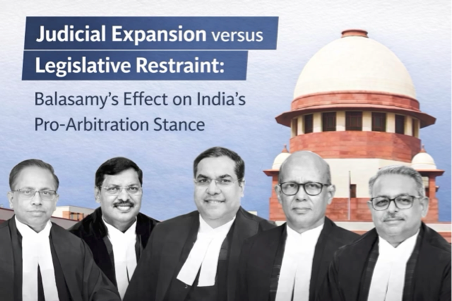
India’s arbitration regime stands at crossroads between judicial expansion and minimal court intervention, following the Apex Court’s ruling in Gayatri Balasamy earlier this year. The five-judged bench interpreted Section 34 of the Arbitration and Conciliation Act, 1996 (‘the Act’) with a 4:1 majority, holding that the courts have the authority to modify awards. This decision seems to deviate from the legislative intent of the Act, which had inculcated of giving limited power to courts to either uphold or set aside awards. The intention of limited intervention was also reaffirmed half a decade ago in the Project Director, NHAI vs. M. Hakeem judgement (‘ Hakeem’), and can once again be seen in the Parliament’s draft Arbitration and Conciliation (Amendment) Bill 2024 (‘the Bill’), which seeks to mould India’s arbitration system to align with international standards.
Although rendered on 30th April 2025, the Gayatri Balasamy judgement has already attracted criticism from leading foreign firms such as Linklaters and Clifford Chance. This article aims to explore the impact of the decision on India’s reputation as a pro-arbitration nation, while also suggesting solutions to address these challenges in light of the Bill.
In Gayatri Balasamy, when the case reached the Supreme Court of India (‘the SCI’), the majority ruled that despite Section 34’s silence, courts can modify awards in certain scenarios such as severance of invalid portions from the valid remainder of the award. Even clerical, typographical, or arithmetic mistakes can be corrected to avoid disproportionate annulments [Para 85]. Additionally, under Section 31(7)(b) of the Act, if there is a deliberate delay by the debtor, a court may adjust interest to reflect the then prevalent economic conditions [Para 75]. The majority based its decision on three pillars: firstly, ensuring efficiency by sparing parties the time and expense of full remission for trivial or severable errors; secondly, by upholding party autonomy on valid grounds without forcing de novo hearings; and lastly, to hold power under Article 142 to do complete justice whenever necessary [Para 84]. The SCI stressed that this power must be exercised sparingly with written reasons and only when there are no other recourses available under Section 33 or Section 34(4) [Para 58 to 63].
The Gayatri Balasamy decision sharply departs from the motive of international arbitrations and the Model Laws’ bright-line approach. Some legal experts are of the view that such a liberal grant of power threatens arbitral finality, since allowing modifications opens the way for broad interpretations by the courts. This may discourage foreign parties that prefer clarity or predictability in outcomes over unpredictable exceptions. This concern becomes even more prominent in the context of India-based international awards since the New York Convention governs only “final” arbitral awards and is silent on the procedure for modified ones, raising a key question regarding governing the enforceability of court-modified international awards.
In late 2024, the Parliament introduced the Bill, which aims to restore the finality of awards and limit civil court interference by channelling review into specialised Appellate Arbitral Tribunals (‘AATs’). Parties may agree, either by incorporation or by post-award consent, to file for appeals on a pure question of law. The AATs must give their decision within 90 days, and their rulings are final and binding with no civil court recourse, much like Singapore’s tribunal appellate review.
It also establishes stricter timelines for judicial processes under sections 8(2), 9(3), 16(5), and 34(6) of the Act. Additionally, it refines the definition of patent illegality to encompass only procedural errors like fraud, biased appointments, and corruption, excluding misapplications of law as seen in the Gayatri Balasamy decision. These changes in the draft bill align with Singapore’s 2002 and 2022 Amendments, and England’s Arbitration acts Sections 67 to 69 all of which prioritize finality, limited court review, and party autonomy. Nevertheless, Gayatri Balasamy’s expansion of Section 34’s scope to permit modification via Article 142, which itself can be widely interpreted, challenges the international trends. Unless the term modification is strictly restricted and defined clearly in statute, it can invite lower courts to interpret the term widely, creating friction between judicial activism and the draft bill’s legislative restraint.
As mentioned above, the SCI has relied on frameworks from global arbitration hubs, like Singapore and the UK. While the English Arbitration Act empowers courts to vary the award in case of challenges made on substantial grounds or appeals on question of law, the Singapore Arbitration Act not only allows the courts to modify the award under an independent provision but also to modify and set aside in the same proceeding.
However, a crucial difference that seems to have been overlooked here is that both these jurisdictions have a clear distinction between their domestic and international arbitration regimes through entirely separate legislations. Contrastingly, the Act does not provide for such a differentiation, other than some segregation within the act itself, that gives a certain leeway for overlaps.
Thus, granting the judiciary a power to modify, in the current framework, poses a legitimate threat of spillovers of judicial interference into the international arbitration regime – which revers the principles of party autonomy and minimal court intervention.
The Gayatri Balasamy judgement poses a further concern in the arbitration fraternity, a worry whether the Indian Judiciary and the Legislature are pulling in different directions? As the courts have broadened the scope of their powers, the Legislature is desperately attempting to build a safe space for international arbitrations and the participants. Such a divergence may erode the consistency and clarity needed for India to build trust as a chosen arbitration seat.
This broadened power of modification introduces apprehensions for uncertainties, delays and an added burden of state interference for an already sceptical foreign entity. These concerns are even more realistic and daunting for a country like India, that regularly battles reputational hurdles regarding enforcement, delays or ‘judicial activism’. With this background, opting for India as a seat for arbitration might become a huge ‘red-flag’ for the cross-border stakeholder.
Recent judicial trends, like in the Jindal Steel case, which increased High Courts’ power to grant relief in Section 9 cases deviating from the ordinary approach, or the DMRC case, where use of extraordinary curative power in contractual dispute was allowed, are to be noted here. These reflect broader powers given to the Indian Judiciary in arbitrations, by allowing courts to intervene in circumstances where they normally have no power, thus reflecting the increase in uncertainty of scope of judicial interferences. This is an interesting observation since simultaneously, foreign investors are resorting to international arbitration as ‘the mechanism’ offering fairness, efficiency and global enforceability. However, when taken into perspective with the enforcement challenges posed by modified awards under the New York Convention, India’s increasing pattern of judicial involvement may scare away the investors.
Every arbitration that fails to deliver an unambiguous and enforceable award diminishes the community’s trust in the process. As the process loses its reliability, these inefficiencies take the form of tangible risks. Consequently, in our attempts to revolutionise the Indian arbitration landscape, it is important to account for the fact the foreign parties and investors employ in-depth cost-benefit analysis before entering the jurisdiction. When these inefficiencies and risks come to light, these businesses may opt to mitigate their exposure, or avoid entering into further commitments altogether. A situation so grave will surely hamper the arbitration haven that we have been trying to make of India.
In our opinion, if at all the courts are to retain the modification principle in the national sphere, it’s scope should be bounded and absolutely restricted from spilling over in the international sphere. There can be a two-pronged approach to achieving this. First, by mirroring the explicit divide of the two regimes as in Singapore or the UK. Such a clear distinction, in the form of separate legislations for domestic and international arbitrations altogether, would relieve the foreign stakeholders of their anxieties with respect to turbulences within the Indian regime. It would allow them the relief of a separate and stable dispute resolution mechanism, making India a preferable seat of arbitration.
In the domestic sphere, authors believe there is a severe need for proper codification of the term ‘modification’ and its power, along with its extent and limitations within the statute itself. Recent applications of the Gayatri Balasamy decision show that the power to modify is not a complete vice but can, in fact, be a strategic tool to save the award. For instance, in Proteus Ventures vs Archilab Designs, the Bombay High Court upheld the award partially after removal of the element of joint liability of Designated Partners, being the limited intervention by the Court, considering that such joint liability is not interlinked or interconnected with rest of the arbitral award. Codification of the power would therefore add to this benefit, by silencing the concerns regarding misuse by courts, making it a powerful weapon in the arbitral arsenal of Indian commerce. As emphasized by Arvind Datar, legitimacy in arbitration comes not just from procedural fairness, but from respecting the finality that parties contract for.
The Gayatri Balasamy judgement reaffirms the judiciary’s role in Indian arbitration in a bold way. There is no doubt it must be a calculated move in the court’s wisdom, however it risks undermining the legislative trajectory that India has been taking towards establishing itself as an International Arbitration hub. In its efforts to live up to its aspirations, India must ensure that judicial discretion does not come at the cost of institutional trust. The Indian arbitration landscape is open for reforms, but priority should be given to those that safeguard the sanctity of arbitral processes, especially in the eyes of the global community.
Copyright© 2026 Milon K. Banerji Centre for Arbitration Law instituted at NALSAR University of Law, Hyderabad. All rights reserved.