
By Arjun Singh.
Arjun Singh is a 5th Year, BA.LLB (Hons.), SVKM’s Pravin Gandhi College of Law, Mumbai.
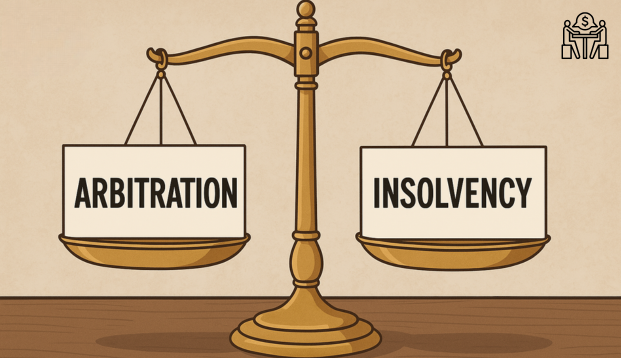
This article examines the jurisdictional fragmentation at the intersection of arbitration–insolvency frameworks in India. It argues that recent judicial developments have produced a structurally incoherent dispute resolution framework in which commercially indivisible, group-based disputes are forcibly split across arbitral and insolvency fora. While arbitration law has evolved to accommodate composite disputes and non-signatory participation, the insolvency regime remains rigidly entity-centric, leading to parallel proceedings, inconsistent fact finding, and remedial dissonance. The article further demonstrates how fraud claims and recovery mechanisms are jurisdictionally decoupled, rendering adjudication and enforcement forum-dependent rather than merit-based.
Keywords: Composite disputes, Insolvency, Arbitration
Indian courts are increasingly grappling with commercial disputes that venture into both arbitral and insolvency fora. Once invoked, the IBC regime practically ousts the jurisdiction of the arbitral tribunal. However, for the purpose of this piece, the conflict examined is not of statutory priority, but of fragmented adjudication, where disputes, despite being commercially and factually indivisible, proceed in parallel before different forums.
Modern commercial disputes rarely arise within the confines of a single bilateral contract. They emerge from corporate groups which have layered holding structures, intertwined guarantees, upstream and downstream transactions, and coordinated conduct across multiple legal entities. The current arbitration landscape has evolved over the years to accommodate this reality by recognising that corporate groups often operate as “single economic units”, a principle crystallised by Hon’ble Supreme Court (SC) in Cox & Kings v. SAP India Pvt. Ltd. (Cox & Kings) and Mahanagar Telephone Nigam Limited v. Canara Bank and Ors. This framework permits the inclusion of non-signatory affiliates where common intention, composite nature of transactions, and conduct demonstrating consent are established. In contrast, IBC remains fixated to the legal personality of the individual corporate debtor (CD). Though courts have occasionally permitted substantive consolidation where group entities’ affairs are inextricably linked, there is no statutory recognition of this doctrine. This divergence is not coincidental but stems from fundamentally different regulatory objectives. Insolvency proceedings being in rem in nature, are inherently non-arbitrable, and the mandatory moratorium under Section 14 creates an exclusive jurisdictional space around the corporate debtor. This structure frequently results in the parallel adjudication of disputes that are commercially indivisible, notwithstanding their composite character.
This piece argues that recent judicial developments in this arena has produced a structurally incoherent dispute resolution system in which composite disputes are forcibly split across fora, fraud is jurisdictionally compartmentalised into contractual and statutory silos, and remedies arising from the same transaction are adjudicated parallelly with no mechanism for reconciliation. The result is procedural inconvenience, conflicting factual findings, and concomitantly a remedial dissonance. This fragmentation is a direct result of superimposing an entity-centric insolvency framework onto an arbitration regime that has recognised and devised mechanism for group wide dispute resolution.
[1] Indus Biotech Private Limited v. Kotak India Venture (Offshore) Fund 2021 SCC OnLine SC 268
A composite dispute involves multiple parties, including non-signatories to the arbitration agreement, where the causes of action are so inextricably linked that effective adjudication is impossible without their collective consideration. Indian arbitration regime has moved from the rigid non-bifurcation of cause of action approach adopted in to a group-oriented framework in Cox & Kings thereby recognising principle that consent to arbitration may be inferred from conduct and the economic unity of the transaction.
This doctrinal evolution culminated in ASF Buildtech Pvt. Ltd. v. Shapoorji Pallonji and Company Pvt. Ltd. (ASF Buildtech) where the SC affirmed the arbitral tribunal’s power to implead non-signatories where they were integral to the transaction and formed part of the same economic group. This was a conscious response to the inadequacy of bilateral arbitration clauses in capturing modern corporate risk allocation. From an arbitration law standpoint, ASF Buildtech restores coherence by ensuring that disputes are adjudicated in a single forum capable of addressing the entirety of the commercial controversy, an endorsement of consolidation that collides with the entity-centric architecture of insolvency law. Arbitration law thus moved decisively toward aggregation, consolidation, and group-level accountability.
IBC on the other hand, approaches the same disputes through an explicitly entity centric standpoint. On admission of Corporate Insolvency Resolution Process (CIRP), Section 14 imposes moratorium rendering the CD procedurally unavailable to all external adjudicatory processes and isolates all the consolidating claims within the insolvency process.
Despite recognition of group insolvency as a commercial reality (SBI v. Videocon Industries), IBC’s statutory design refrains from group level adjudication, treating each CD as a legally independent unit to preserve collective resolution and creditor equality.
The overlap of ASF Buildtech and Section 14 exposes a structural tension. While arbitration law endorses consolidation of composite disputes across corporate groups, insolvency law mandates separation. On admission of CIRP, proceedings against the subsidiary are stayed, However, the arbitration may continue against solvent group entities under the expanded Group of Companies doctrine. The problems with this fragmentation are clear: liability within corporate groups is often coextensive or derivative, arises from guarantees, integrated contractual arrangements and obligations. Adjudicating the liability of one entity in isolation risks inconsistent determination.
Consider a composite arbitration in which, a claimant initiates arbitration against a subsidiary (the primary obligor) and its Parent (the non-signatory guarantor) under the Group of Companies doctrine. Upon the subsidiary’s admission into CIRP, the arbitration against it is stayed by Section 14. However, the proceeding continues against the solvent parent. The claimant is now forced to prove the subsidiary’s underlying default before an arbitral tribunal to hold the Parent liable, while simultaneously proving the exact same debt as a “claim” before a Resolution Professional (RP) in the CIRP.
Comparative jurisdictions have adopted calibrated thresholds to prevent jurisdictional severance while preserving objective of insolvency legislations. For example in Singapore, the Court of Appeal in AnAn Group (Singapore) Pte Ltd v. VTB Bank adopted a “prima facie” standard as per which, the insolvency proceedings are ordinarily stayed if the debt is subject to a “prima facie” valid arbitration agreement. This approach gives priority to initial determination of the debt in the contractually designated forum, preventing insolvency proceedings from superseding arbitral adjudication at the threshold.
The position of United Kingdom was articulated in Sian Participation Corp v. Halimeda International Ltd, where, the Privy Council held that winding-up proceedings are displaced by an arbitration clause where the debt is genuinely disputed on substantial grounds. This approach distinguishes clear default from complex commercial disputes without permitting tactical obstruction. Globally, guidelines by United Nations Commission On International Trade Law i.e. UNCITRAL Model Law on Enterprise Group Insolvency (2019) recognises the need for coordinated adjudication across group enterprises. While the Indian judiciary in Videocon Industries has recognized the doctrine of substantive consolidation in exceptional cases, it remains subject to strict limits and is yet to receive formal statutory recognition. Consequently, a standardized legislative framework for coordinated adjudication remains absent in the Indian context.
This divergence is even more evident in fraud-based disputes. In Avitel Post Studioz Ltd. v. HSBC PI Holdings Ltd. (Avitel), the SC departed from the conventional view that fraud is per se non-arbitrable and held that civil or contractual fraud may be referred to arbitration unless it implicates public rights or affects the validity of the arbitration agreement.
On the other hand, Section 66 of the IBC treats fraud as a statutory wrong. It authorises the NCLT to order contributions to the insolvency estate from persons who have conducted business with the CD with intent to defraud creditors, with the focus on restoring estate value rather than compensating individual claimants.
Therefore, there might be a case where same transaction may give rise to two jurisdictionally distinct fraud claims one being a contractual fraud arbitrable under the Avitel logic, and other being a statutory fraud under the IBC, actionable exclusively before the NCLT. This bifurcation reflects differences in how fraud is addressed under arbitration law and the IBC respectively. Whereas the Arbitration Act addresses private disputes between parties, IBC targets the conduct that prejudices the collective body of creditors.
The limited scope of Section 66 exacerbates this jurisdictional fragmentation. In Glukrich Capital Pvt. Ltd. v. State of WB, the SC construed Section 66 as being strictly restricted to those “carrying on” the business of the debtor. Basis which, the courts have largely confined its application to directors and persons in management of the CD, excluding solvent third parties or group affiliates not formally involved in the management of the corporate debtor. Consequently, where funds are siphoned to related parties or third-party vendors, IBC lacks jurisdiction to bind all participants to a single proceeding.
The RP is therefore compelled to bifurcate enforcement pursuing statutory proceedings against management before the NCLT, while initiating civil or arbitral proceedings against third parties elsewhere, resulting in forum splitting and fragmented adjudication of a single fraud transaction before different fora.
From the perspective of remedies advanced, a fundamental tension exists between the collective, status-based nature of insolvency and the bilateral, contract-based nature of arbitration. While both fora offer a diverse range of reliefs, including specific performance and damages in arbitration or reorganization and liquidation in insolvency, their underlying objectives remain inherently at odds. This diversion becomes all the more contentious in light of recent jurisprudence on the allocation of recoveries from avoidance and fraud actions.
In Piramal Capital & Housing Finance Ltd. v. 63 Moons Technologies Ltd., the SC clarified that recoveries from avoidance transactions may accrue in favour of successful resolution applicant if the resolution plan provides so. This highlights proprietary transformation effected by resolution plans under which statutory recoveries are no longer automatically preserved for creditors whose claims gave rise to the proceedings.
Arbitration, by contrast, awards damages to the claimant, subject to the extinguishment of claims under the resolution plan. Thus, the same fraudulent transaction may yield a windfall recovery for a resolution applicant through insolvency proceedings, while leaving an individual claimant remediless in arbitration due to the “clean slate” doctrine. As a result, allocation of value becomes contingent not on wrongdoing, but on the forum in which recovery is pursued. This critique doesn’t dispute the legitimacy of insolvency finality or the clean slate doctrine per se, but its spillover effect in rendering parallel arbitral adjudication substantively and remedially otiose.
This disjunction spills even to enforcement stage. As held in Electrosteel Steel Ltd. v. Ispat Carrier Pvt. Ltd., arbitral awards based on claims extinguished by an approved resolution plan may be resisted at the execution stage, arbitral finality is therefore rendered contingent on subsequent insolvency outcomes, disconnecting adjudication from enforceability. Thus, Electrosteel further stretches the doctrine of jurisdictional nullity by treating statutory extinguishment of debt under an approved resolution plan as a jurisdictional fact. Consequentially, the MSME creditors, particularly those proceeding before Facilitation Councils may secure arbitral awards post-CIRP which are doctrinally valid yet effectively unenforceable in other words, merely “paper decrees”.
Together, these effects produce a system in which remedies and enforcement are fragmented across fora, governed by different objectives and insulated from coordination. The law offers no settled approach for reconciling these outcomes, compelling creditors to strategize around jurisdiction rather than merits.
Recent legal development demonstrates that conflicts between arbitration and insolvency extend beyond questions of statutory precedence. While arbitration law has evolved to accommodate composite, group-based disputes, insolvency law continues to operate through an entity-centric framework even where the transaction is commercially indivisible. Decisions such as ASF Buildtech and Electrosteel demonstrate how arbitral reach is expanded even as arbitral outcomes are neutralised through insolvency finality, producing jurisdictional fragmentation and remedial incoherence. In the absence of mechanisms for coordinated adjudication, the resolution of complex commercial disputes risks becoming forum dependent, leaving the reconciliation of these regimes an unresolved judicial challenge.
Copyright© 2026 Milon K. Banerji Centre for Arbitration Law instituted at NALSAR University of Law, Hyderabad. All rights reserved.